
Parent-Child Bonding: How Shared Stories, Games, Nature and Play Support a Child’s Emotional Health
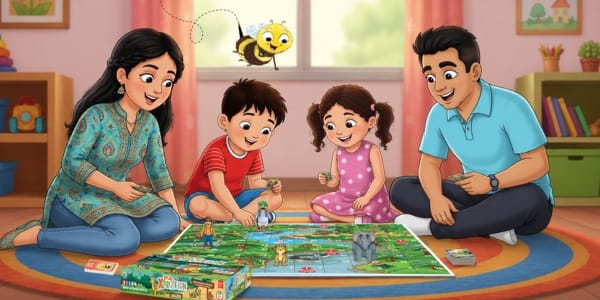
There is a lot of talk about children’s mental health today.
And rightly so.
Children are growing up in a world that is busy, noisy, competitive and often far too fast. Between school, activities, screens, peer pressure, exams, social expectations and the general rush of modern family life, children can sometimes feel overwhelmed in ways they may not know how to express.
As parents, we often look for solutions outside.
A class.
A schedule.
A worksheet.
A new activity.
A better routine.
A professional intervention, when needed.
All of these have their place.
But one of the most powerful foundations for a child’s emotional health is also one of the simplest:
A strong parent-child bond.
Children who feel seen, heard and emotionally safe at home are better able to manage stress, build confidence, express feelings, ask questions and recover from small disappointments. Bonding does not mean hovering over children every minute. It does not mean entertaining them all day. It does not mean becoming their best friend at the cost of parenting.
It simply means creating regular moments of connection.
A story read together.
A board game on the floor.
A walk in nature.
A DIY kit built with much confusion and laughter.
A cricket session in the compound.
A puzzle solved slowly.
A conversation where the child feels truly heard.
These moments may look ordinary.
They are not.
They are the quiet architecture of emotional security.
Adventures of Biplob the Bumblebee
Quick answer: how does parent-child bonding support emotional health?
Parent-child bonding supports a child’s emotional health by helping the child feel safe, loved, heard and understood. Shared activities such as reading Biplob books, playing board games, solving puzzles, building DIY kits, spending time in nature and simply listening to children can improve confidence, communication, emotional regulation and family connection.
The important thing is not the perfection of the activity.
It is the quality of attention.
A child remembers that you listened.
A child remembers that you played.
A child remembers that you laughed together.
A child remembers that you put the phone away.
A child remembers that, for a while, they had you.
That is bonding.
And it matters more than we sometimes realise.
Why parent-child bonding matters
Children do not always say, “I need emotional connection.”
They are far more likely to say:
“Look at this.”
“Come here.”
“Play with me.”
“Can I tell you something?”
“See what I made.”
“Guess what happened today.”
“Just five minutes.”
Sometimes, these requests arrive at inconvenient times.
Usually, in fact.
But beneath many of them is a simple need: the child wants to feel that they matter.
Parent-child bonding gives children that feeling. It tells them: you are important, your thoughts matter, your feelings matter, your stories matter, your questions matter, and your presence is welcome.
This does not mean dropping everything every single time. That is neither practical nor healthy. But it does mean creating enough regular moments where the child does not have to fight for attention.
Over time, these moments build trust.
And trust is at the heart of emotional well-being.
Bonding is not about grand gestures
A lot of parents assume bonding requires elaborate planning.
A holiday.
A weekend outing.
A fancy activity.
A perfect family day.
A beautifully arranged craft table no one is allowed to mess up.
Not really.
Children are surprisingly happy with small, repeated moments.
Ten minutes of reading.
Fifteen minutes of catch.
A walk to the park.
A board game after dinner.
A puzzle on the floor.
A colouring page together.
A plant watered every morning.
A DIY kit assembled over two evenings.
A conversation at bedtime.
These things may not look impressive on social media.
Which is often a good sign.
Because real bonding is not always photogenic. It is usually messy, funny, interrupted, imperfect and deeply human.
Stories help children talk about feelings
Children often find it easier to talk about a character’s feelings than their own.
This is why books are so powerful for emotional health.
A story creates distance. A child can discuss fear, kindness, anger, courage, jealousy, worry, friendship or sadness through a character, without feeling exposed.
“What do you think Biplob felt?”
“Why did the character help?”
“Was that a kind thing to do?”
“What would you have done?”
“Do you think the character was scared?”
These questions can open doors.
Books like Adventures of Biplob the Bumblebee can help children explore kindness, care, empathy, courage and responsibility through story-led learning. Nature-led stories are especially useful because they combine emotional awareness with curiosity about the world.
A child may begin by following a bumblebee.
Then she begins to notice care, friendship, helpfulness and courage.
That is emotional learning through story.
Adventures of Biplob the Bumblebee
Detective stories help children think and express
Not every child wants to sit down and “talk about feelings.”
Some children open up better through mystery, humour, observation or problem-solving.
This is where detective stories and thinking games can help.
A child following Detective Col. Zoro may begin with clues and curiosity, but along the way learns observation, patience, listening and reasoning. These skills are useful beyond the story. They help children slow down, notice details and think before reacting.
Similarly, a game like Reduce to Deduce can encourage children to ask questions, think aloud, test possibilities and discuss ideas with parents. This is parent-child bonding at its best: shared thinking, shared laughter, shared mistakes and shared discovery.
Not a lecture.
A conversation disguised as play.
Play builds emotional safety
Play is not a waste of time.
It is how children process the world.
When parents play with children, something important happens. The adult enters the child’s world. Not as an instructor. Not as a critic. Not as the person saying “hurry up.” But as a participant.
This can be deeply reassuring for a child.
Board games are especially useful because they create a shared structure. Everyone knows the rules. Everyone gets a turn. Everyone experiences winning, losing, waiting, planning, trying again and occasionally accusing someone of cheating.
All very educational.
A family board game can quietly teach emotional skills:
Patience.
Turn-taking.
Resilience.
Problem-solving.
Communication.
Healthy competition.
Managing disappointment.
Celebrating someone else’s win.
These are not small lessons.
They are life lessons, delivered through laughter.
DIY kits give parents and children something to build together
There is something wonderful about making something with your hands.
Especially when it does not go perfectly the first time.
A STEM.org certified DIY kit gives parents and children a shared project. They follow steps, sort parts, make mistakes, fix them, try again and finally create something tangible.
This is useful for more than STEM learning.
It teaches patience. It teaches collaboration. It teaches children that not knowing what to do immediately is not failure. It teaches them that adults also get confused, read instructions badly, put pieces in the wrong place and occasionally pretend they meant to do that.
That is good for children to see.
When a parent and child build together, the child experiences shared effort. Not performance. Not comparison. Just making, solving and laughing together.
That builds emotional connection.
Nature time is bonding time
Some of the best parent-child conversations happen outdoors.
Not across a table.
Not during a lecture.
But while walking.
There is something about nature that softens conversation. Children who may not speak much at home sometimes open up while looking at ants, kicking stones, spotting birds, collecting leaves or walking beside a parent without direct eye contact.
Nature gives children space to breathe.
It also gives parents a break from constantly managing the next task.
A walk in the park, a few minutes on the grass, watching bees near flowers, watering plants, observing clouds, or simply sitting under a tree can do more for emotional well-being than we imagine.
You do not need to turn every nature outing into a lesson.
Please don’t.
Let it be slow. Let it be playful. Let the child notice what interests them.
One child may love insects. Another may collect leaves. Another may chase butterflies. Another may simply run until tired.
All of it counts.
Adventures of Biplob the Bumblebee
Share what you know
We have all played some sport or learnt some skill while growing up.
Use that.
Share what you know with your child.
It could be cricket, football, squash, chess, sketching, cooking, gardening, music, cycling, storytelling, repairing something at home, or even how to make the perfect paper boat.
In my case, it was cricket.
We would have hour-long fun coaching sessions in the building compound. What began with me chucking the ball as my son worked on his footwork slowly bloomed into something bigger. His friends asked to join. Before I knew it, I was coaching a bunch of children and referring to videos to keep up with them.
Forget bonding with only my own son. I had somehow become the proud mentor to a small group of budding cricketers.
The point is not whether the child becomes good at the skill.
The point is that you are sharing something of yourself.
Children value that.
Listen properly
Listening is one of the most underrated forms of parenting.
Children often come to us with things that seem unimportant.
A drawing.
A broken toy.
A small fight.
A strange question.
A long story with no obvious plot.
A puzzle they are trying to solve.
A mystery they have invented.
A complaint about someone who looked at them “in a mean way.”
To us, it may seem trivial.
To them, it may be the most important thing in the world at that moment.
When possible, pause and listen properly. Even two minutes of complete attention can mean a great deal to a child.
This does not mean every interruption must be rewarded. Children also need to learn boundaries. But when we do listen, we should listen well.
Put the phone down. Look at them. Ask one real question.
A child who feels heard is far more likely to come back when something bigger needs to be said.
That is why listening supports emotional health.
Grab the moment
Some of the best bonding moments are unplanned.
One afternoon, the children were playing catch in the same room where I was trying to concentrate. I could have scolded them. I probably almost did.
Instead, I joined in.
With one condition: each throw had to come with a question. A math sum, a capital city, a word, a verb, an adjective, anything.
What followed was 40 minutes of bonding, learning, laughing, relaxing and recharging.
It became a ritual of sorts.
Catch-catch tables.
Catch-catch capitals.
Catch-catch grammar.
Catch-catch whatever came to mind.
The lesson?
Sometimes it is good to drop everything and do something fun together.
Not always.
But sometimes.
Children remember those moments. So do parents.
Team up on everyday chores
Household chores do not sound like bonding opportunities.
But they can be.
Dusting. Folding clothes. Watering plants. Sorting toys. Fixing something small. Arranging books. Cleaning a shelf. Preparing a simple snack.
When done together, even ordinary chores can create a feeling of teamwork.
Children like being useful. They like being trusted. They like feeling that they are contributing to the family.
Of course, they may also do the chore badly.
That is part of the package.
The goal is not perfection. The goal is participation.
When children help at home, they learn responsibility and belonging. When parents do chores with them, the work becomes less of an order and more of a shared activity.
That matters.
Create family rituals
Rituals are powerful because they give children something to look forward to.
A Friday board game night.
A Sunday nature walk.
A bedtime story.
A monthly DIY project.
A puzzle afternoon.
A colouring session after lunch.
A family movie night followed by drawing favourite scenes.
A plant-watering routine.
A “one new board game” weekend.
Rituals do not have to be elaborate.
They just have to be consistent enough to become meaningful.
A child who knows that Friday is game night or Sunday is park morning has something emotionally steady to hold on to.
That steadiness supports well-being.
Reduce screens without making it a battle
Parent-child bonding is harder when everyone is looking at a different screen.
This does not mean screens must disappear. That is neither realistic nor necessary.
But shared screen-free time matters.
Reading together, playing board games, solving puzzles, building DIY kits, colouring, walking outdoors and talking without digital interruption all give children something screens cannot always provide: shared presence.
The child is not merely entertained.
The child is accompanied.
That is a big difference.
Parent-child bonding supports emotional resilience
Children cannot be protected from every disappointment.
Nor should they be.
They will lose games. Make mistakes. Fight with friends. Struggle with schoolwork. Feel left out. Feel angry. Feel sad. Feel confused. Feel afraid.
A strong parent-child bond does not remove these experiences.
It gives children a safe place to bring them.
That is emotional resilience.
The child learns: I can feel upset and still be loved. I can make a mistake and still be accepted. I can ask for help. I can try again. I can talk about difficult things.
This is why bonding is not a luxury.
It is part of mental and emotional health.
Explore bonding through stories, games and hands-on play
Parent-child bonding does not require complicated planning.
Start small.
Read together.
Play together.
Walk together.
Build together.
Listen properly.
Share what you know.
Create one simple ritual.
To make these moments easier, start with:
- Adventures of Biplob the Bumblebee
- Detective Col. Zoro
- Biplob books
- Reduce to Deduce board game
- Net Zero board game
- Xpedition board game
- Story-based jigsaw puzzles
- Colouring books for kids
- STEM.org certified DIY kits
Each one gives parents and children a different way to read, think, play, build, solve, imagine and connect.
Explore Family Bonding Activities
In the end
There is no rocket science here.
Our children want to spend time with us.
And, though we may forget it in the rush of daily life, we want to spend time with them too.
The trick is not to wait for perfect conditions.
Start with ten minutes.
One story.
One game.
One walk.
One puzzle.
One DIY project.
One conversation.
One moment where the child feels seen.
These small moments build the bond.
And that bond, over time, becomes one of the strongest supports for a child’s emotional and mental well-being.
Because children do not need perfect parents.
They need present ones.
FAQs on Parent-Child Bonding and Emotional Health
Why is parent-child bonding important for emotional health?
Parent-child bonding helps children feel safe, loved, heard and understood. This emotional security supports confidence, communication, resilience and better mental and emotional health.
How can parents bond with their children?
Parents can bond with children through simple shared activities such as reading together, playing board games, solving puzzles, building DIY kits, spending time in nature, sharing a skill, doing chores together and listening properly.
How do books help parent-child bonding?
Books give parents and children a shared story world. Reading together encourages conversation, imagination, empathy and emotional expression. Biplob books and Detective Col. Zoro stories can help children explore feelings, curiosity, kindness and problem-solving.
What board games can families play together?
Families can play board games that encourage thinking, problem-solving, sustainability learning, ecosystems and deduction. Games like Reduce to Deduce, Net Zero and Xpedition can support bonding while helping children think and communicate.
How do DIY kits help children bond with parents?
DIY kits give parents and children a shared hands-on project. Building together supports patience, teamwork, problem-solving, confidence and family connection.
[Hyperlink: STEM.org certified DIY kits → DIY Kits collection]
Why is time in nature good for parent-child bonding?
Nature gives children and parents space to slow down, talk, observe and play without pressure. Walks, gardens, parks, plants and outdoor play can support calm, curiosity and emotional well-being.
What are good screen-free bonding activities for families?
Good screen-free bonding activities include reading Biplob books, playing board games, solving story-based jigsaw puzzles, colouring, building DIY kits, walking in nature, gardening, cooking together and playing a sport.