Why Teaching Kids About Sustainability Matters More Than Ever
Quick Answer
Teaching kids about sustainability helps them understand how their actions affect the world around them. More importantly, it develops responsibility, empathy, critical thinking and a lifelong appreciation for nature. Children who learn sustainable habits early are more likely to grow into adults who make thoughtful choices for themselves, their communities and the planet.
Why Sustainability Education Cannot Wait
If there is one thing we leave behind for our children, it is not our homes, our possessions or our bank balances.
It is the planet itself.
That may sound dramatic, but spend five minutes reading the news and you’ll quickly realise that our children are growing up in a world facing challenges that previous generations could scarcely imagine. Hotter summers, shrinking green spaces, water shortages, pollution and biodiversity loss are becoming everyday realities.
Like an old saying goes, we borrow the Earth from our children; we do not inherit it from our ancestors. The least we can do is empower them to care for it better than we have.
The purpose of sustainability education is not to scare children.
It is to empower them.
It is to help them understand that even small actions matter.
And children, when given the opportunity, are remarkably capable of making a difference.
The Numbers Tell the Story
Sustainability isn’t simply a good idea anymore. It is rapidly becoming an essential life skill.
According to UNICEF, nearly one billion children worldwide are at extremely high risk from the impacts of climate change, including water shortages, heatwaves and environmental degradation.
The United Nations Environment Programme (UNEP) continues to warn that global temperatures are on track to exceed safe thresholds unless significant emissions reductions occur this decade.
Meanwhile, reports from the Intergovernmental Panel on Climate Change (IPCC) consistently show that today’s children will experience far more climate-related events throughout their lives than previous generations.
These statistics are not meant to frighten children.
They are meant to remind us that preparing them for the future requires more than academic education alone.
Adventures of Biplob the Bumblebee
Net Zero
Xpedition
Story-based Jigsaw Puzzles
STEM.org Certified DIY Kits
Children Are the Future Caretakers of the Planet
As parents, we spend years teaching children habits that will serve them throughout life.
We teach them to brush their teeth.
We teach them to wash their hands.
We teach them to say “please” and “thank you.”
Teaching sustainability belongs on that same list.
When children learn to conserve water, reduce waste, recycle responsibly and care for nature, they develop habits that often stay with them for life.
The objective isn’t to create environmental activists overnight.
The objective is to raise thoughtful human beings who understand that their actions have consequences.
And that they have the power to choose wisely.
Sustainability Teaches More Than Environmental Awareness
One of the biggest misconceptions about sustainability education is that it is only about protecting nature.
In reality, sustainability teaches some of life’s most important values.
Responsibility
When children remember to switch off a light or water a plant, they begin to understand that their actions matter.
Responsibility develops when children realise something depends on them.
Empathy
A child who learns about animals, plants and ecosystems begins to see themselves as part of a larger world.
That awareness naturally encourages empathy.
Not just towards nature, but towards people too.
Critical Thinking
Sustainability encourages children to ask meaningful questions.
Why should we recycle?
Where does rubbish go?
Why is water important?
What happens when forests disappear?
These questions encourage curiosity and deeper thinking.
Problem Solving
Children love solving problems.
Present them with a challenge such as reducing household waste or saving water and they often come up with ideas adults would never have considered.
In many homes, sustainability education eventually results in children reminding their parents to switch off lights.
Sometimes repeatedly.
The Secret Ingredient: Helping Kids Fall in Love with Nature
Many parents discover the same thing.
Telling children to “save the environment” rarely inspires them.
Helping them love nature does.
Children protect what they care about.
A child who spends time chasing butterflies, planting seeds, watching insects or exploring forests develops a personal connection with nature.
That connection is far more powerful than any lecture.
This is why spending time outdoors is one of the most effective forms of sustainability education.
Nature does most of the teaching.
We simply need to create opportunities for children to experience it.
Sometimes the Best Lessons Happen on the Road
One of the things we’ve always done as a family is carry garbage bags in our car whenever we head out on road trips.
Initially, the bags were there for practical reasons. Long drives with children tend to generate a surprising collection of snack wrappers, fruit peels, juice cartons and assorted bits of rubbish.
Over time, though, something interesting happened.
The children began using those bags without being asked.
Then they started noticing litter at scenic viewpoints and picnic spots.
That inevitably led to questions.
“Why would someone leave rubbish here?”
“Doesn’t this spoil the place?”
“What happens to all this plastic?”
Those conversations turned out to be some of the most valuable sustainability lessons we’ve ever had.
Not because we were trying to teach them.
But because they genuinely cared.
The simple act of carrying a garbage bag transformed into discussions about waste, responsibility and respecting the places we visit.
Sometimes the most powerful lessons happen when we aren’t trying to teach at all.
Simple Ways to Teach Sustainability at Home
The beauty of sustainability education is that it doesn’t require expensive resources or complicated lessons.
Some of the most effective learning happens through everyday habits.
Encourage your children to:
- Turn off lights and fans when leaving a room.
- Switch off the tap while brushing.
- Use reusable water bottles.
- Separate recyclable materials.
- Reuse materials for school projects.
- Avoid wasting food.
- Grow and care for a plant.
- Spend more time outdoors exploring nature.
These actions may seem small individually.
Collectively, they teach children that positive change starts with everyday choices.
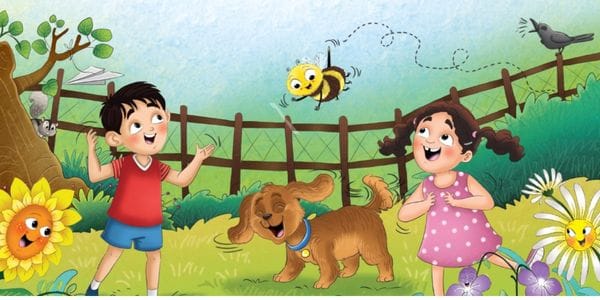
For younger children, stories often make sustainability concepts easier to understand than facts and figures. Story-based learning resources such as the Biplob sustainability collection can help children connect environmental responsibility with everyday actions in ways that feel engaging and memorable.
For older children, hands-on STEM projects focused on conservation, recycling and nature exploration can transform awareness into action.
Because sustainability is not just something children should learn about.
It is something they should experience.
Adventures of Biplob the Bumblebee
Free Download: Family Sustainability Challenge
Why not turn sustainability into a family adventure?
Family Sustainability Challenge Checklist
- Turn off lights when leaving a room
- Switch off the tap while brushing
- Plant and care for a seedling
- Spend one screen-free afternoon outdoors
- Reuse materials for a craft project
- Carry reusable water bottles for an entire week
- Pick up litter during a family walk
- Learn about a local bird, insect or tree
- Reduce food waste for seven consecutive days
- Complete a family nature walk and discuss what you discovered
You may be surprised how quickly children become the sustainability champions of the household.
Sustainability Is About Progress, Not Perfection
Many parents worry that they aren’t environmentally perfect themselves.
The truth is that perfection isn’t the goal.
Progress is.
Children don’t need perfect role models.
They need authentic ones.
When they see us carrying reusable bags, reducing waste, respecting nature and making conscious choices, they learn that sustainability is simply part of everyday life.
And that lesson is far more powerful than any lecture.
Conclusion
Teaching kids about sustainability isn’t really about saving the planet.
At least, not only.
It is about raising thoughtful, responsible, curious and compassionate human beings.
It is about helping children understand that they are connected to the world around them and that their choices matter.
Most importantly, it is about giving them hope.
Because when children understand both the challenges and the solutions, environmental problems stop feeling overwhelming.
Instead, they become opportunities.
Opportunities to learn.
Opportunities to help.
Opportunities to make a difference.
And perhaps that is the greatest sustainability lesson of all.
The future is not something our children simply inherit.
It is something they help create.
Frequently Asked Questions
Why is it important to teach sustainability to children?
Teaching sustainability helps children develop responsibility, empathy, environmental awareness and lifelong habits that positively impact both people and the planet.
At what age should children learn about sustainability?
Children can begin learning sustainability concepts as early as preschool through gardening, recycling and nature-based play.
How can parents teach sustainability at home?
Parents can model sustainable habits, involve children in recycling, encourage water conservation and spend time exploring nature together.
What are the benefits of sustainability education?
Sustainability education builds critical thinking, responsibility, problem-solving skills, empathy and environmental awareness.
Why is nature important for sustainability learning?
Children are more likely to protect what they love. Time spent in nature creates emotional connections that encourage environmental responsibility.
What are some easy sustainability activities for kids?
Planting seeds, recycling, composting, nature walks, litter collection and creating crafts from recycled materials are excellent starting points.
Adventures of Biplob the Bumblebee
Story-Based Jigsaw Puzzles