Buzz for Local: Teaching Children Make in India, Healthy Choices and Sustainability Through Everyday Decisions
Few things beat the sheer pleasure of savouring a succulent dragon fruit from Mexico, a crisp apple from Washington, or the explosion of flavour that comes from biting into a juicy kiwi flown in from some distant corner of the world.
The last couple of decades have seen exotic foods from across the world making their way to Indian dining tables. Spanish kale, South American avocado, Andean quinoa, Turkish garbanzo beans, imported berries, New Zealand kiwis — you name it, and chances are someone has turned it into a superfood smoothie.
Besides the taste and aspirational value, there are the health benefits that are often touted. And yes, many of these foods are nutritious.
But there is another side to this story.
Each time we consume a fruit or vegetable that has travelled thousands of kilometres to reach our kitchens, we are also consuming the hidden cost of transport, refrigeration, packaging, storage, emissions and lost opportunity for local producers.
That does not mean we must never eat anything imported.
It does mean we should ask a simple question more often:
Can we choose something local, seasonal and equally good instead?
That one question connects beautifully with three large ideas shaping India’s future: Make in India, Ayushman Bharat and Viksit Bharat.
Because local choices are not only about food.
They are about health, sustainability, self-reliance, imagination, design, enterprise and the kind of India we want our children to build.
Adventures of Biplob the Bumblebee
Quick answer: how do local choices help children understand Make in India and sustainability?
Local choices help children understand that what we buy, eat, use, design and make has consequences. Choosing local and seasonal food can reduce unnecessary transport, support Indian farmers, encourage healthier eating and build respect for Indian resources. Stories, board games and DIY kits such as Adventures of Biplob the Bumblebee, Net Zero, Xpedition and STEM.org certified DIY kits can help children connect Make in India, sustainability, health and problem-solving through play.
Why “local” matters more than we think
Buying local sounds simple.
Almost too simple.
But it carries several lessons children can understand quite easily.
A fruit grown nearby does not need to travel across oceans.
A vegetable grown in season usually needs less artificial intervention.
A local farmer gets supported.
A family spends less.
A child learns that India grows plenty of good food.
A household reduces avoidable waste and emissions.
This is sustainability in everyday form.
Children may not immediately understand carbon emissions, refrigerated containers, global supply chains or foreign exchange bills. But they can understand that a guava from a local market has had a shorter journey than an imported fruit that crossed continents.
They can understand that a banana grown in India may be just as nourishing as a more glamorous imported option.
They can understand that choosing local is not about being old-fashioned.
It is about being sensible.
Make in India begins with respect for what India makes
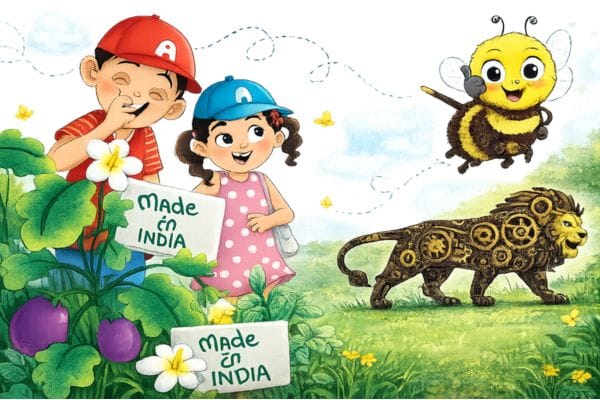
When we hear Make in India, we often think of factories, technology, manufacturing, start-ups, design, defence, electronics or large industry.
All of that matters.
But the idea also begins much closer home.
It begins when children learn to respect what is grown, made, designed, built and imagined in India.
The local fruit in the kitchen.
The Indian storybook on the shelf.
The board game designed around sustainability.
The DIY kit that lets a child build with her hands.
The puzzle that turns Indian imagination into play.
The character who helps children see nature differently.
Children should grow up knowing that good things do not only come from somewhere else.
They can be imagined here.
Designed here.
Made here.
Played here.
Read here.
Built here.
That is where confidence begins.
From imported aspiration to local confidence
Let us be honest.
A lot of imported consumption is not driven by need.
It is driven by aspiration.
The imported fruit on the table.
The foreign brand in the cupboard.
The exotic ingredient in the lunchbox.
The product bought because it sounds more refined.
There is nothing wrong with enjoying something from another country. Trade and exchange have enriched civilizations for centuries.
The problem begins when imported automatically becomes superior in our minds.
Children absorb this very quickly.
If we constantly signal that foreign is better, local becomes second-rate before it even gets a fair chance. But if we show children that Indian fruits, Indian stories, Indian games, Indian design and Indian ideas can be rich, imaginative and world-class, we are doing something far more important than making a purchase.
We are building cultural confidence.
That matters deeply for a Viksit Bharat.
A developed India will not be built only by consuming better.
It will be built by imagining, designing, making and valuing better.
Ayushman Bharat begins with everyday health
Ayushman Bharat is often discussed in terms of healthcare access, hospitals, insurance and systems.
But health also begins at home.
It begins in the food we eat, the habits we build, the air we breathe, the water we save, the time we spend outdoors, and the choices we make daily.
A child who eats seasonal fruits and vegetables, spends time in nature, plays actively, learns about food, understands waste and participates in family decisions is already learning health in a practical way.
Local and seasonal food helps here beautifully.
Indian bananas, guavas, oranges, apples, papaya, jackfruit, amla, mangoes, millets, leafy greens and regional vegetables are not poor substitutes for imported superfoods. Many are nutritional powerhouses in their own right.
The humble guava does not need a foreign accent to be good for you.
Nor does the banana.
Nor does amla.
This is an important lesson for children.
Health is not always found in fancy packaging.
Nutrition is not always imported.
Good food often grows closer than we think.
Sustainability is easier when children can see the journey
One of the easiest ways to explain sustainability to children is to talk about journeys.
Ask them:
Where did this fruit come from?
How far did it travel?
Was it grown nearby?
Was it in season?
How was it packed?
How long did it need to be stored?
Could we have chosen something local instead?
You do not need to turn every meal into a lecture.
Please don’t.
But the occasional question can make a child think.
A Washington apple or imported kiwi may have travelled thousands of kilometres. It may have been stored, refrigerated, packaged and transported for weeks before reaching the market. In comparison, a locally grown apple, guava, banana, orange or seasonal fruit may have had a far shorter journey.
This is the beginning of understanding food miles.
Not as a textbook concept.
As a kitchen-table conversation.
A game like Net Zero can make this idea even easier to understand because it helps children see how choices around resources, emissions and responsible decisions affect outcomes.
Net Zero: helping children understand the impact of choices
Children often hear phrases like “carbon footprint,” “greenhouse gases” and “net zero,” but these can be difficult to understand.
A board game can make the idea far more accessible.
Through Net Zero, children can begin to understand that every decision has an implication. Use more. Waste more. Save more. Choose better. Plan better. Balance resources. Reduce impact.
The language may be adult.
The logic is not.
Children understand games because games make consequences visible. A choice is made, and something happens. That is exactly what sustainability is about.
When a child plays a sustainability-themed game, she is not merely being entertained. She is practising decision-making.
And decision-making is at the heart of responsible citizenship.
Xpedition: helping children understand ecosystems
If Net Zero helps children understand choices, Xpedition can help them understand systems.
And sustainability is all about systems.
Food systems.
Water systems.
Ecosystems.
Local economies.
Habitats.
Resource cycles.
Human choices.
A fruit is not just a fruit. It is connected to soil, water, farmers, transport, markets, weather, insects, storage and consumption.
A bee is not just an insect. It is connected to flowers, pollination, food, biodiversity and farming.
A forest is not just trees. It is a living network.
Through a game like Xpedition, children can begin to see how ecosystems fPractical ways to bring “local” home
unction and why balance matters. Once they understand that nature is interconnected, choosing local, wasting less and respecting resources begins to make more sense.
Biplob helps children connect with nature
Before children care about sustainability, they must first care about nature.
This is where stories help.
In Adventures of Biplob the Bumblebee, children enter the natural world through the adventures of a small but meaningful character. Biplob allows children to see bees, flowers, kindness, care and responsibility through story rather than instruction.
A child may not care about pollination as a scientific term.
But she may care about a bumblebee.
And once she cares about the bumblebee, she begins to care about flowers. Then gardens. Then food. Then the natural systems that make life possible.
That is how environmental awareness grows.
Not through fear.
Through connection.
Adventures of Biplob the Bumblebee
Imagine, design and make in India
Children need more than consumption choices.
They need creation choices.
This is where Make in India becomes especially relevant for learning.
It is not enough to tell children to buy local. We must also encourage them to imagine local, design local and make local.
Can they design a poster about seasonal fruits?
Can they build a model using reused materials?
Can they create a board game around food miles?
Can they map where their lunch ingredients came from?
Can they make a craft project using old paper instead of new paper?
Can they invent a story about a local fruit or insect?
Can they build something with a DIY kit and understand how parts come together?
This is where STEM.org certified DIY kits become useful. They encourage children to build, test, observe, solve and create. A child who makes something with her hands begins to understand design, effort, material, process and outcome.
That is the foundation of making.
And a country that wants to build a Viksit Bharat needs children who do not merely consume.
It needs children who imagine, design, build and solve.
Local food is also local economy
Supporting local is not only about emissions.
It is also about livelihoods.
When we buy local fruits and vegetables, we support farmers, vendors, transporters, small retailers and regional supply chains. The money circulates closer to home. The child begins to see that the local market is not just a place to buy things. It is an ecosystem of people and work.
This is a powerful idea.
Children should know that behind every fruit is a farmer. Behind every vegetable is labour, soil, water, weather, risk and effort.
Once they understand that, food waste becomes harder.
The half-eaten fruit left on the plate is no longer just “food.” It is someone’s work.
This is where values like gratitude, responsibility and respect enter the conversation.
And those values are essential for any developed society.
Local does not mean boring
One reason children may resist local food is that adults often make it sound like a compromise.
“Eat this because it is good for you.”
That sentence has defeated many excellent vegetables.
Instead, make local food interesting.
Create a seasonal fruit chart.
Visit a local market.
Let children choose one local fruit each week.
Do a blind taste test.
Compare imported and local varieties.
Make a family rule: one seasonal Indian fruit every day.
Start a “buzz for local” challenge at home.
Children enjoy ownership.
Let them choose. Let them compare. Let them ask. Let them discover that Indian food diversity is enormous.
The point is not to ban imported foods.
The point is to make local visible, valued and exciting.
Practical ways to bring “local” home
Here are simple ways families can begin:
1. Choose seasonal fruits first
Before buying imported fruit, ask what is in season locally. Mangoes, guavas, bananas, oranges, apples, papaya, grapes, melons, amla and regional fruits offer plenty of variety.
2. Visit a local market with your child
Let your child see colours, textures, vendors, bargaining, baskets and seasonal abundance. A supermarket shelf hides the story. A market reveals it.
3. Ask where food comes from
Not every day. Just occasionally. Turn it into curiosity, not interrogation.
4. Compare food miles
Show children that some foods travel farther than others. Use a map if needed.
5. Reduce food waste
Serve smaller portions. Take more if needed. Respect what is on the plate.
6. Reuse for school projects
Use old newspapers, cardboard, cartons and fabric scraps before buying new material.
7. Play games that explain choices
Use board games to help children understand sustainability, resource use and ecosystems.
Use puzzles and colouring books to extend the idea
Not every learning moment needs to be serious.
Sometimes a child colouring a fruit, bee, flower or farm scene is also learning. Sometimes a child solving a puzzle is quietly understanding how parts form a whole.
A Biplob colouring book can help children slow down and engage with nature through creative expression. A story-based jigsaw puzzle can help them understand connection, patience and observation.
These are small things.
But small things matter.
A child who notices details is more likely to ask questions.
And questions are the beginning of learning.
A Viksit Bharat needs conscious children
A developed India cannot be built by infrastructure alone.
It needs healthy children. Curious children. Environmentally aware children. Children who respect local resources. Children who understand systems. Children who value Indian ideas. Children who know how to imagine, design, build and solve.
That is where these everyday lessons matter.
Choosing local food teaches sustainability.
Choosing seasonal food teaches health.
Playing Net Zero teaches consequences.
Playing Xpedition teaches ecosystems.
Reading Biplob teaches care for nature.
Building with DIY kits teaches making.
Solving puzzles teaches patience.
Colouring teaches attention.
None of these is dramatic on its own.
Together, they build a mindset.
And mindsets build nations.
Explore Make in India learning through stories, games and making
If we want children to value local, we must give them local stories, local games, local imagination and local making.
Start with:
- Adventures of Biplob the Bumblebee
- Net Zero board game
- Xpedition board game
- STEM.org certified DIY kits
- Story-based jigsaw puzzles
- Colouring books for kids
- Biplob books
Each one gives children a different way to imagine, design, make, play, solve and care — right here in India.
Explore Make in India Learning Products
In the end
So if you want to do your bit for the planet, your child’s health, local producers and the idea of a stronger India, you do not need to begin with a grand declaration.
Begin with the fruit bowl.
Begin with the local market.
Begin with a story.
Begin with a game.
Begin with a DIY kit.
Begin with a question:
“Can we choose something local?”
Because local is not merely about where something is grown or made.
It is about awareness.
It is about respect.
It is about reducing avoidable waste.
It is about supporting people closer to home.
It is about helping children see India not just as a market, but as a place of imagination, design, making and possibility.
Much like the hardworking bee, all we need to do is buzz for local.
And perhaps, in doing so, raise children who are healthier, more aware, more confident and more ready to build the Viksit Bharat they will inherit.
FAQs on Local Choices, Make in India and Sustainability for Kids
Why should children learn to choose local?
Children should learn to choose local because it helps them understand sustainability, food journeys, local farmers, seasonal eating, waste reduction and responsible consumption. It also builds respect for what is grown, made and designed in India.
How does choosing local food help sustainability?
Choosing local food can reduce unnecessary transport, storage, packaging and refrigeration. It also supports local farmers and helps children understand the environmental impact of everyday food choices.
How does this connect with Make in India?
Make in India is about valuing what India can grow, design, produce and create. Children can understand this through local food, Indian storybooks, board games, DIY kits, puzzles and hands-on making activities.
How does local food connect with Ayushman Bharat?
Ayushman Bharat is connected to the larger idea of a healthier India. Local and seasonal food can help families build healthier eating habits and teach children that nutrition does not always need to come from imported or expensive foods.
How can Net Zero help children understand sustainability?
Net Zero helps children understand how choices around resources, waste, energy and sustainability have consequences. It turns climate and sustainability thinking into a board game experience.
How can Xpedition help children understand ecosystems?
Xpedition helps children understand how ecosystems function and why balance matters. It shows how plants, animals, habitats and human choices are connected.
How do Biplob books support local and sustainability learning?
Biplob books help children connect with nature, bees, flowers, kindness and responsibility through Indian storytelling. They make environmental learning emotional, simple and memorable.
Adventures of Biplob the Bumblebee
What products help children imagine, design and make in India?
Biplob books, Net Zero, Xpedition, STEM.org certified DIY kits, story-based jigsaw puzzles and colouring books help children imagine, design, play, build, solve and learn through Indian-made stories and activities.