
Why We Should Let Children Try Before Deciding What They Can Do
Children learn stereotypes in surprisingly ordinary ways.
Nobody necessarily sits a little boy down and tells him that sport is for boys. Nobody formally informs a girl that engineering isn’t really her thing.
It is usually much subtler.
“Wouldn’t your brother like the cricket bat?”
“Why don’t we get her a craft set?”
“The boys can carry these chairs.”
“Can one of the girls help me with the little children?”
Mostly innocent. Often well-intentioned.
But children are excellent observers, and gradually they begin assembling these little clues into rules about the world.
Boys do this. Girls do that.
And that can become a problem when the rule stops a child from even trying.
Quick Answer: How Can Parents Challenge Gender Stereotypes?
One of the simplest ways to challenge gender stereotypes in children is to offer opportunities before making assumptions about interests or abilities.
A girl doesn’t need to be pushed towards sport because she’s a girl. Nor does a boy need to be encouraged to cook merely to prove a point.
Offer both the opportunity.
Let them try.
Then allow ability, enthusiasm and plain old personal preference to take over.
That distinction is at the heart of The Racquet Racket, the first story in Biplobworld’s Girls = Boys, Each Unique series.
But Aren’t Boys and Girls Different?
Yes.
And that’s perfectly alright.
Gender parity does not require us to pretend biological differences don’t exist. Nor does it require us to pretend every child has identical abilities.
Spend ten minutes with a group of children and that idea disappears fairly quickly anyway.
One will run faster. Another will have better coordination. One can concentrate for astonishing lengths of time while another appears to have been fitted with an internal motor.
Children are different.
The question is whether gender alone should be enough to decide what opportunity a child gets.
Very often, it shouldn’t.
And sport gives us a particularly useful example.
When “Boys Are Stronger” Becomes the Entire Argument
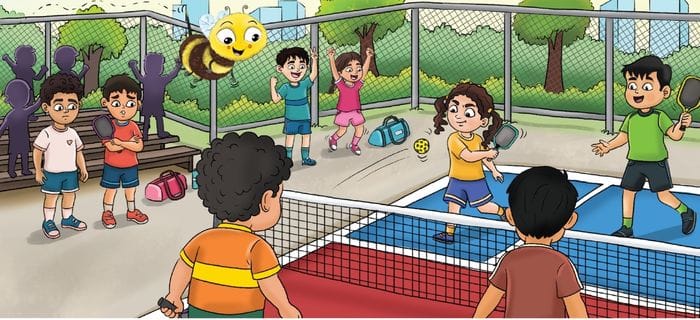
In The Racquet Racket, Avantika and her friends are preparing for their school’s pickleball trials. Two boys, Deepak and Rajul, dismiss the possibility that Avantika could be as good as them.
Their reasoning?
She is a girl.
They argue that they are stronger and therefore she could never be better than them at any sport. Biplob points out the rather obvious hole in this argument: pickleball isn’t a weightlifting or wrestling competition. It requires several different skills.
And this is where an entertaining children’s story raises a surprisingly grown-up question.
Are we judging the skills actually required—or simply relying on an assumption?
A sport might require speed, coordination, accuracy, endurance, strategy, anticipation, balance or teamwork.
Strength can matter.
But so can an awful lot of other things.
The same applies far beyond sport.
Ask “What Does This Need?” Rather Than “Who Usually Does This?”
This is a wonderfully useful habit to encourage in children.
Suppose something heavy needs moving.
Strength matters.
Suppose a team needs someone who can solve a complicated puzzle.
Problem-solving matters.
Suppose somebody needs to comfort a frightened younger child.
Empathy and patience matter.
Once we identify the actual ability required, gender often becomes remarkably irrelevant.
This is precisely what happens in The Racquet Racket. Avantika’s friends recognise that she plays as well as the others. What matters isn’t whether she is a girl. What matters is whether she can play pickleball.
It sounds obvious when written down.
Unfortunately, stereotypes have an annoying habit of making obvious things less obvious.
Equal Opportunity Doesn’t Guarantee Equal Results
This is another distinction worth teaching children.
Everyone deserves a fair chance. That doesn’t mean everyone will be equally good at everything.
Some children will make the team.
Others won’t.
Someone will win the race.
Someone else will finish last.
Gender equality doesn’t require us to engineer identical outcomes or protect children from discovering that somebody else is better at something.
It means the opportunity to participate shouldn’t disappear because we made a judgement before the child even began.
That makes the message much more useful than simply saying, “Girls can do anything boys can do.”
Perhaps a particular girl can’t.
Perhaps a particular boy can’t either.
Let ability answer the question—not gender.
Watch the Language We Use at Home
Parents don’t need to turn every conversation into a seminar on gender equality.
In fact, please don’t.
But we can pay attention to the casual assumptions we make.
Would we ask our daughter to help assemble the new bookshelf?
Would we invite our son into the kitchen?
Do we automatically describe a physically adventurous girl as a “tomboy”?
Do we assume the boy will enjoy the football class and the girl the dance class before either has expressed an opinion?
These tiny moments matter because childhood is largely a process of trying things and discovering yourself.
A child who repeatedly receives the message “that’s not really for you” may eventually stop asking.
The Important Thing Is the Opportunity
There is another lovely moment in The Racquet Racket.
After the disagreement, Biplob encourages Riya—who has never played pickleball—to join the group. She plays squash, another racquet sport, so her friends realise some of those skills may transfer.
She is uncertain.
They offer to teach her.
Biplob’s advice is simple: she has the opportunity; now she needs to work hard and make the most of it.
That is a far more useful version of equality.
Opportunity isn’t the finish line.
It is the starting line.
Children still need to practise, learn, fail, improve and occasionally discover that they are absolutely dreadful at something.
That’s part of growing up too.
Let Stories Start the Conversation
Gender stereotypes can become a rather heavy subject when adults approach children with explanations, definitions and lectures.
Stories give us another route.
In Biplobworld’s Girls = Boys, Each Unique series, we wanted the adventure to come first.
In The Racquet Racket, children encounter a pickleball trial, friendships, rivalry, teasing and a talking bumblebee who initially thinks pickleball might involve making pickles.
The stereotype appears naturally within that story.
So does the challenge to it.
A child can therefore reach the important conclusion without someone standing over the book explaining what she is supposed to learn.
After reading, parents can simply ask:
“Do you think Deepak was right?”
“How could he know Avantika wasn’t good enough before playing against her?”
“Have you ever thought something was only for boys or only for girls?”
Then see where the conversation goes.
You might learn something too.
Give Them the Racquet
As parents, we can’t remove every stereotype our children will encounter.
Nor do we need to pretend boys and girls are identical.
What we can do is prevent assumptions from becoming unnecessary fences around childhood.
Offer the football.
Offer the science kit.
Offer the paints.
Offer the cooking spoon.
Offer the doll.
Offer the toolbox.
And then watch what happens.
Some children will surprise us. Some won’t. Some will try something once and never touch it again.
That’s fine.
Because the objective was never to decide the outcome.
It was to give them the chance.
That’s the idea behind The Racquet Racket, the first story in Biplobworld’s Girls = Boys, Each Unique series: don’t decide what a child can do simply by looking at whether that child is a girl or boy.
Give them the racquet first.
Then let them show you how they play.
FAQs
What are gender stereotypes for children?
Gender stereotypes are assumptions that children should behave in particular ways, enjoy certain activities or possess particular abilities simply because they are boys or girls.
How can parents reduce gender stereotypes at home?
Offer children a wide variety of toys, sports, responsibilities and learning experiences without automatically assigning them by gender. Let children’s individual interests and abilities guide what happens next.
Does gender parity mean boys and girls are biologically identical?
No. Gender parity is about equitable opportunities, not biological sameness. Children can have different physical characteristics and individual abilities while still deserving a fair opportunity to participate, learn and develop.
Can children’s stories help challenge gender stereotypes?
Yes. Stories allow children to encounter stereotypes through characters and situations rather than through abstract lectures. Biplobworld’s Girls = Boys, Each Unique series uses this story-first approach, allowing the gender-parity lesson to emerge organically from the adventure.