
Learning Together: Why Everyday Skills Shouldn’t Be Divided by Gender
I remember watching a seven-year-old neighbour play-acting when I was a child.
She had draped her mother’s dupatta around herself and was pretending to speak to her imaginary husband.
“Don’t forget to get the vegetables on your way home from work,” she told him.
There was nothing particularly remarkable about it.
She was simply playing house, copying the grown-ups she saw around her—as children have done forever.
And yet, that image has stayed with me.
Perhaps because, even at that age, her little game spoke volumes about how tasks and responsibilities were divided at home.
The husband went to work.
The wife ran the household.
He brought home the vegetables.
She presumably turned them into dinner.
It was innocuous enough. And it was.
Nobody had sat this little girl down and handed her a rulebook titled Things Men Do and Things Women Do.
They didn’t need to.
She had been watching.
And children are exceptionally good at that.
They watch who cooks dinner.
Who fixes something when it breaks.
Who goes to work.
Who buys the groceries.
Who looks after the children.
Who handles the money.
Then they take all these little observations and begin constructing their own picture of how the world works.
There is nothing wrong, of course, with a mother cooking dinner or a father buying the vegetables. Families divide responsibilities in whatever way works for them.
The problem comes when children begin interpreting what they repeatedly see as a rule:
Mothers do this. Fathers do that.
Girls are good at this. Boys are supposed to do that.
And eventually:
This isn’t for me.
That’s why teaching children gender equality isn’t only about telling them that boys and girls can do the same things.
They need opportunities to see it, try it and live it.
Because if children can learn gender roles by watching everyday life, everyday life is also one of the best places to challenge them.
Quick Answer: How Can Everyday Life Skills Teach Gender Equality?
Give boys and girls opportunities to learn a broad range of practical skills together.
Cooking, cleaning, organising, basic repairs and looking after yourself aren’t inherently male or female activities. They’re simply useful things to know.
Children don’t have to enjoy every task equally or become equally good at everything. The important thing is that gender doesn’t decide who gets to learn.
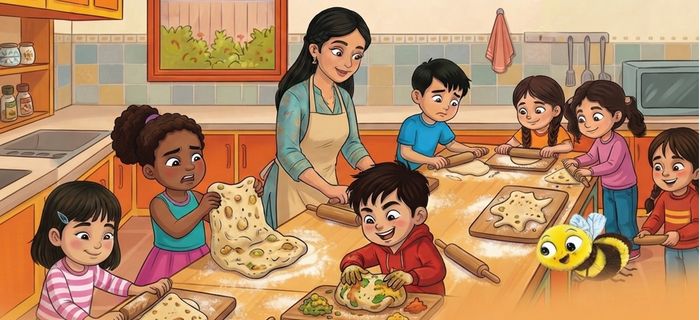
That’s one of the ideas brought to life in the third story of Biplobworld’s Girls = Boys, Each Unique – Book 3.
Children Don’t Just Listen to What We Teach. They Watch What We Do.
That little girl with her mother’s dupatta hadn’t been taught a lesson about gender roles.
At least, not deliberately.
She was reproducing what looked normal to her.
And that’s worth remembering because parents can say all the right things about equality while everyday life quietly tells children a different story.
We might tell our daughter:
“Girls can do anything boys can do.”
Wonderful.
But if her brother is always invited to help Dad fix something while she’s asked to help Mum in the kitchen, she’s receiving another message at the same time.
Likewise, we can tell our son that men and women are equal.
But if he grows up believing cooking, cleaning and caring for other people will somehow be somebody else’s responsibility, he’s learned a gender role too.
Not because anybody formally taught him.
Because normal is one of childhood’s most persuasive teachers.