
Let Children Choose: Hobbies and Skills Don’t Need a Gender
Children have an impressive ability to decide what they like.
Dinosaurs.
Painting.
Football.
Dancing.
Baking.
Collecting rocks that apparently must accompany you home from every holiday.
Left entirely to themselves, their interests can wander in wonderfully unpredictable directions.
Then somebody comes along and says:
“That’s for girls.”
Or:
“Boys don’t do that.”
And suddenly a perfectly ordinary choice becomes something a child has to defend.
That’s the curious thing about gender stereotypes.
They don’t always tell children that they can’t do something.
Sometimes they do something subtler.
They make children feel embarrassed for wanting to do it.
Quick Answer: Should Children’s Interests Be Defined by Gender?
No.
Children should have the freedom to explore hobbies, skills and activities according to what interests them—not according to whether those activities are traditionally associated with boys or girls.
That doesn’t mean every child needs to try everything.
It simply means we shouldn’t make children feel that an activity is somehow wrong for them because of their gender.
That’s the idea at the heart of A Growing Tribe, the second story in Biplobworld’s Girls = Boys, Each Unique – Book 3.
When Cooking Suddenly Becomes “Girlish”
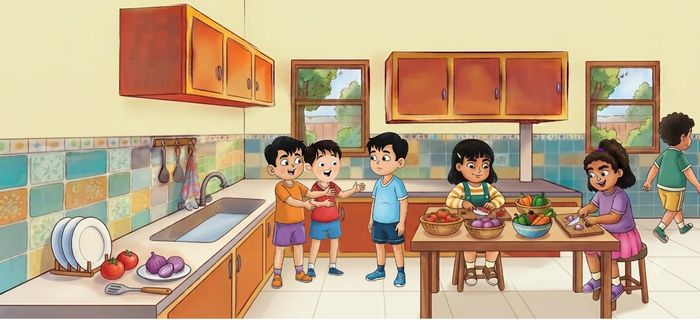
By the beginning of A Growing Tribe, Adi is counting down to his Saturday cooking lesson.
His friends are getting involved too.
Asif already helps his father, Chef Quraishy, in the kitchen sometimes. Riya thinks cooking sounds fun. The children discuss menus, recipes, ingredients, spices and condiments while playing pickleball.
It’s all rather normal.
Until Deepak hears about it.
He mocks Adi for spending time with girls and says that learning to cook and clean is turning the boys into “sissies.”
According to him, cooking and cleaning are jobs for women and girls.
And there it is.
The activity hasn’t changed.
The children’s enthusiasm hasn’t changed.
The only thing that’s changed is that somebody has attached a gender label to it.
Children Learn What They’re “Supposed” to Like
Nobody is born believing sautéing vegetables is feminine.
Or football is masculine.
Or pink belongs to girls.
Or tools belong to boys.
Children learn these associations.
Sometimes from advertising.
Sometimes from friends.
Sometimes from stories and entertainment.
And sometimes from the adults around them without any of us consciously intending to teach them.
“He won’t like that—it’s a girls’ activity.”
“She’s not really into boys’ things.”
“That’s a funny hobby for a boy.”
These comments can sound harmless.
But children are very good at listening.
Particularly when we wish they weren’t.
Over time, they can begin building a mental list of things they’re expected to enjoy.
The Problem Isn’t Preference
There is an important distinction here.
Gender equality doesn’t mean boys and girls must all develop identical interests.
A boy may genuinely prefer football to cooking.
A girl may genuinely prefer dance to building model aeroplanes.
Nothing wrong with either.
The problem begins when we decide what a child will probably like before giving that child the opportunity to discover it.
Or when a child already likes something and we make them feel self-conscious about it.
The goal isn’t to eliminate differences.
It’s to give children room to discover which differences are actually theirs.
“Anyone Can Do What They Enjoy”
Adi’s response to Deepak is worth noting because he doesn’t launch into a grand speech about equality.
He simply asks:
“What is wrong with learning to cook and clean?”
When Deepak insists these are jobs for women and girls, Adi replies that no work is only for boys or only for girls.
People can do what they enjoy, are good at, or what needs to be done.
That gives children three wonderfully practical ways to think about activities.
Do I enjoy it?
Am I good at it—or would I like to become good at it?
Is it something that needs doing?
Gender doesn’t need to appear anywhere on the list.
Judgement Can Stop Children Before They Start
This is why teasing matters.
Adults can sometimes dismiss children’s comments as harmless banter.
And sometimes it is.
But imagine a child who is already slightly uncertain about trying something new.
A boy wants to dance.
A girl wants to join a robotics club.
A boy wants to learn sewing.
A girl wants to try cricket.
Then another child laughs.
“That’s for girls.”
“That’s a boys’ thing.”
It doesn’t necessarily take a formal prohibition to stop them.
Embarrassment can do the job perfectly well.
Children want to belong.
If exploring an interest risks ridicule or exclusion, some will decide the interest isn’t worth the social cost.
And that’s how stereotypes quietly shrink choices.
Sometimes Courage Is Simply Saying, “Can I Join?”
This is why Rajul is, for me, the most interesting character in A Growing Tribe.
Deepak has made his opinion abundantly clear.
Cooking is girlish.
Boys who want to learn are “sissies.”
Then Rajul speaks.
Rather uncertainly at first.
He asks Adi whether the cooking class is happening at his home.
Then:
Can he join too?
Deepak is horrified.
Rajul knows exactly what his friend thinks about the idea.
But this time he doesn’t follow him.
He tells Deepak that he agrees with Adi.
That’s a lovely little moment of courage.
Not the jumping-from-a-burning-building variety.
Just a child deciding:
I want to do this, and your opinion isn’t going to decide for me.
Children need that kind of courage too.
Give Children Permission to Be Beginners
Another reason children hesitate to cross traditional gender boundaries is that they may be inexperienced.
A girl trying a traditionally male-dominated activity may be surrounded by boys who’ve been doing it for years.
A boy trying something traditionally associated with girls may feel equally exposed.
So don’t expect instant brilliance.
A first attempt can be terrible.
That’s rather what first attempts are for.
Instead of:
“Maybe this isn’t really your thing.”
Try:
“You’re still learning.”
The difference is enormous.
Children need enough time with an activity to decide whether they genuinely dislike it—not merely whether they’re currently bad at it.
Watch the Labels We Put on Activities
One simple thing parents can do is remove unnecessary gender labels from everyday conversation.
Not:
“Would you like to try a girls’ craft activity?”
Just:
“Would you like to try this?”
Not:
“She’s very sporty for a girl.”
She’s sporty.
Not:
“He’s surprisingly interested in cooking.”
He likes cooking.
The less extraordinary we make these choices sound, the more ordinary they become.
And ordinary is useful.
We don’t want a boy who cooks to feel like he’s making a statement about gender equality every time he chops an onion.
Sometimes he’s just making lunch.
We Don’t Need to Force the Choice Either
There’s a trap on the other side.
In our enthusiasm to challenge stereotypes, we can start pushing children towards non-traditional activities simply to prove a point.
That isn’t freedom either.
If your daughter has tried football and hates it, she doesn’t need to continue playing to represent womankind.
If your son would rather eat the cake than bake it, civilisation will survive.
The point is choice without judgement.
Expose children to possibilities.
Encourage curiosity.
Don’t assume.
Then allow them to decide.
A Growing Tribe
The title of the story becomes particularly apt towards the end.
Rajul wants to join.
Asif then invites Megha and Pinky.
They agree.
Suddenly the Saturday cooking session has become bigger, more varied and considerably more interesting.
Nobody has joined because cooking belongs to boys.
Nobody has joined because cooking belongs to girls.
They’ve joined because they want to learn.
That’s what gender parity can look like in ordinary childhood.
Not boys versus girls.
Not proving that one gender can do what the other does.
Just children having enough freedom to explore what interests them.
Some will discover lifelong passions.
Others will try something once and never touch it again.
Both outcomes are fine.
Because the lesson isn’t:
You must like this.
It’s:
You’re allowed to find out whether you do.
And perhaps that’s one of the best gifts we can give children.
A world of possibilities before somebody starts dividing it into pink and blue boxes.
FAQs
How do gender stereotypes affect children’s interests?
Gender stereotypes can make children feel that certain hobbies, subjects or skills aren’t appropriate for them. Even when children aren’t explicitly prevented from participating, teasing or expectations can discourage them from exploring an interest.
Should parents encourage gender-neutral activities?
Parents can offer children a broad range of activities without labelling them as masculine or feminine. The goal isn’t to make every child enjoy the same things, but to give them genuine opportunities to discover their own interests.
What should I do if my child is teased for liking a “girls’” or “boys’” activity?
Acknowledge how the teasing made them feel, while reinforcing that hobbies and skills don’t belong to one gender. Help the child focus on whether they enjoy the activity rather than whether somebody else approves of it.
Does gender equality mean boys and girls should have the same hobbies?
No. Gender equality doesn’t require identical preferences. Children are individuals and will naturally enjoy different things. Equality means those choices shouldn’t be unnecessarily limited by gender.
How can parents avoid reinforcing gender stereotypes?
Watch the language used around toys, activities, chores, school subjects and careers. Rather than describing something as a boys’ or girls’ activity, present it as an option and let the child respond according to interest.
What does A Growing Tribe teach children about gender parity?
In A Growing Tribe, Deepak mocks Adi and Asif for learning to cook because he believes cooking and cleaning are for girls. Adi challenges that assumption, while Rajul chooses to join the cooking lesson despite Deepak’s judgement. The story shows that children should be free to learn, participate and make choices according to their interests rather than gender stereotypes.