Sustainability for Kids: Why It Should Feel Like a Way of Life, Not a Compromise
The case for creating awareness about sustainability in early childhood could not be stronger.
If for no other reason, then because the Earth is the only thing we actually leave behind for our children.
There is an old saying that we do not inherit the Earth from our ancestors; we borrow it from our children. Whether or not one remembers the exact wording, the meaning is hard to ignore. The least we can do is empower children to care for it better than we have.
But here is where we often make a mistake.
We introduce sustainability as a sacrifice.
Don’t waste this.
Don’t use that.
Don’t buy this.
Don’t throw that.
Don’t leave the light on.
Don’t keep the tap running.
All useful instructions.
Also, not the most inspiring way to introduce a child to the idea of caring for the planet.
Children should not grow up believing that sustainability means giving up joy, comfort, fun or imagination. It should not feel like punishment. It should not sound like a long list of things they are not allowed to do.
Sustainability, introduced well, can feel like a way of life.
A better way to notice.
A better way to use.
A better way to choose.
A better way to play.
A better way to care.
And the earlier we introduce this idea, the more naturally it becomes part of childhood.
Quick answer: why should children learn sustainability early?
Children should learn sustainability early because habits formed in childhood often become lifelong behaviours. When sustainability is introduced through stories, games, nature, play and simple daily actions, children understand that caring for the planet is not a compromise. It is a normal and joyful way of living. Books like Adventures of Biplob the Bumblebee, games like Net Zero and Xpedition, story-based puzzles, colouring books and STEM.org certified DIY kits can help children understand sustainability through experience rather than lectures.
Adventures of Biplob the Bumblebee
Net Zero
Xpedition
STEM.org Certified DIY Kits
Sustainability should not feel like less
For many adults, sustainability sounds like reduction.
Use less.
Buy less.
Waste less.
Travel less.
Consume less.
There is truth in that, of course. Mindless consumption is a problem. Waste is a problem. Using resources carelessly is a problem.
But for children, if sustainability is introduced only as “less,” it can feel dreary very quickly.
So we need to show them the other side.
Sustainability is also more.
More imagination.
More creativity.
More time in nature.
More thoughtful choices.
More curiosity.
More hands-on play.
More respect for what we have.
More joy in making something last.
More pride in doing the right thing.
A child who reuses a cardboard box to build a fort is not experiencing deprivation.
She is creating.
A child who grows a plant is not sacrificing.
She is caring.
A child who plays a game about sustainability is not being lectured.
She is discovering.
That distinction matters.
The problem with “save the planet” lectures
A lot of parents find that simple sustainability suggestions are met with a familiar response:
“But why should I do this?”
Typical answers like “it saves the environment” or “it avoids wastage” often draw little or no interest. Not because children are uncaring, but because these answers are too vague.
“The environment” is too large an idea for a child to feel responsible for immediately.
A tap left open is easier to understand.
A plant that droops without water is easier to understand.
A bee searching for flowers is easier to understand.
A game where one choice changes the outcome is easier to understand.
A puzzle where one missing piece affects the whole picture is easier to understand.
Children need sustainability to become visible.
They need to see it, touch it, play with it, question it and experience it.
That is how the idea becomes real.
First, help children love nature
The best way to get children interested in sustainability is to first foster a love for nature.
Once a child becomes a stakeholder in protecting nature, the rules become much easier to understand.
Spend as much time as you can amidst nature with your child. This does not have to mean expensive holidays or elaborate eco-trips. A park, a garden, a balcony plant, a tree outside the window or a patch of grass can all become starting points.
Go for walks. Sit on the grass. Watch insects. Notice birds. Look at flowers. Observe clouds. Follow a line of ants. If you see a bee, pause and watch.
Do not rush to make it educational.
Let it first be enjoyable.
Please resist the temptation to memorise and announce the names of every tree, flower and insect unless your child asks. Just because botanical names interest you does not mean they must interest your child.
One child may spend hours gazing at insects as they go about their job. Another may be fascinated by small animals on the forest floor. Another may love leaves. Another may only want to run in circles.
All fine.
The important thing is that they are there.
Nature will do the rest.
Adventures of Biplob the Bumblebee
Stories make sustainability emotional
Children do not always connect with abstract ideas like sustainability, biodiversity or climate change.
But they do connect with characters.
A bumblebee looking for flowers.
A small creature trying to help.
A forest that needs care.
A garden full of life.
A character who notices what others miss.
That is why stories are such a powerful way to introduce sustainability early.
In Adventures of Biplob the Bumblebee, children meet nature through story. They do not begin with a lecture on pollination, ecosystems or environmental responsibility. They begin with Biplob.
That is important.
A child may not care about the word “biodiversity.”
But she may care about a bumblebee.
And once she cares about the bumblebee, she may begin to care about flowers. Then gardens. Then trees. Then the larger natural world.
This is how sustainability becomes personal.
Adventures of Biplob the Bumblebee
Games make sustainability understandable
Some sustainability ideas are difficult because the consequences are not immediately visible.
If a child leaves the light on, nothing dramatic happens.
If water runs while brushing, the tap still works.
If food is wasted, the plate gets cleared.
If plastic is thrown away, it disappears from the house.
The problem is delayed, hidden or somewhere else.
Games help make consequences visible.
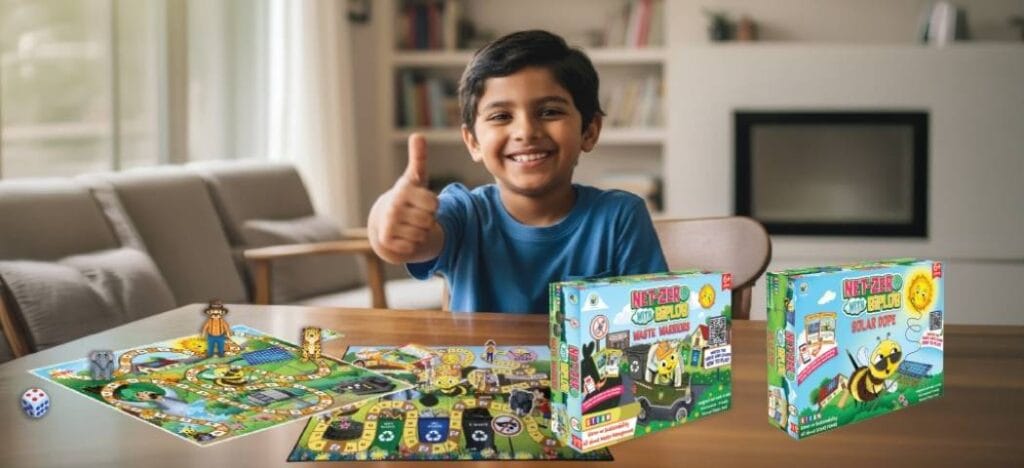
In Net Zero, children can begin to understand that choices around energy, waste, resources and responsibility have outcomes. They can see how one action affects another. They can try, fail, adjust and improve.
That is exactly how children learn.
Not by being told repeatedly.
By experiencing.
Through play, sustainability becomes a decision-making exercise. Children begin to see that every choice matters — not in a frightening way, but in an empowering one.
Ecosystems teach children that everything is connected
Sustainability is not only about switching off lights and saving water.
It is also about understanding connection.
A bee is connected to flowers.
Flowers are connected to food.
Trees are connected to air and shade.
Water is connected to plants, animals and people.
A forest is connected to everything living inside it.
Children understand this beautifully when they experience it through play.
A game like Xpedition can help children understand how ecosystems function. It can show them that nature is not a collection of separate things, but a living network.
When one part is disturbed, another part is affected.
This is one of the most important sustainability lessons a child can learn.
Once children understand connection, responsibility begins to make sense.
Simple habits that make sustainability normal
If we want children to believe sustainability is a way of life, it must show up in ordinary moments.
Not once a year on Environment Day.
Every day.
Here are simple habits that can become part of home life.
1. Switch off what is not being used
Get children to shut all lights, fans, air-conditioners and appliances when leaving a room.
This is a simple, visible habit.
The light is either on or off.
The fan is either running or not.
The charger is either plugged in unnecessarily or not.
Children can easily take responsibility for this. Give them the role of “energy monitor” at home if they enjoy it.
They may become very enthusiastic.
You have been warned.
A game like Net Zero can help them understand that energy choices are part of a larger sustainability picture.
2. Use water consciously
Keep the tap shut while brushing. Turn off the shower when water is not needed.
Children understand water better when they can see how much gets wasted. Let them try brushing with a mug of water. Let them water a plant. Show them how quickly a bucket fills when a tap is left running.
Do not make it scary.
Make it visible.
Once they see the waste, the habit begins to make sense.
3. Reuse before buying new
Reuse anything and everything you can.
Need to do a school project? Use old newspapers instead of buying new paper. Cardboard boxes can become models. Old jars can become storage. Used paper can become rough sheets. Fabric scraps can become craft material.
Children enjoy reuse when it feels like creativity.
This is where STEM.org certified DIY kits can support the larger idea of making, building and problem-solving. When children build with their hands, they begin to understand material, design, effort and outcome.
That is sustainability thinking.
4. Don’t waste resources
Don’t waste anything.
Paper, water, electricity, food, stationery, toys, time outdoors — use what you need, but do not waste it.
This does not mean children must live with less joy.
It simply means they learn to value what they have.
The aim is not to scrounge. The aim is to be mindful.
That difference is everything.
5. Grow and care for a plant
Get children to grow and care for a plant.
The process of watching a seed become a plant is intensely rewarding. It teaches responsibility, patience and pride of accomplishment.
A child who waters a plant learns consistency.
A child who forgets and sees the leaves droop learns consequence.
A child who watches new leaves appear learns joy.
A child who sees flowers bloom learns wonder.
While this is happening, you can gently introduce how plants contribute to cleaner air, shade, food, habitats and beauty.
But again, do not overdo the explanation.
Let the plant do the teaching.
6. Take sustainability indoors through puzzles and colouring
Not every sustainability experience has to happen outdoors.
A Biplob colouring book can help children engage with bees, flowers, trees, gardens and nature through creative expression. While colouring, children notice details. They slow down. They ask questions.
A story-based jigsaw puzzle can help children understand how parts make a whole. A missing piece matters. A wrong piece does not fit. The picture comes together only when everything is connected.
That is a rather lovely metaphor for sustainability.
Sustainability is not a single subject
One reason sustainability should be introduced early is that it is not one subject.
It touches everything.
Science.
Food.
Water.
Health.
Nature.
Design.
Consumption.
Waste.
Imagination.
Empathy.
Problem-solving.
Citizenship.
A child who learns sustainability early is not merely learning to switch off lights. She is learning to think about consequences. She is learning to notice systems. She is learning to value resources. She is learning to care for living beings. She is learning that choices matter.
This is why early childhood is such an important stage.
At this age, habits are not yet rigid. Attitudes are still forming. Curiosity is alive. Wonder is easy. A child can still be amazed by a seed, a bee, a puddle, a leaf or a worm.
We should use that window well.
Make sustainability feel joyful, not heavy
Climate change and environmental damage are serious topics.
But children do not need to carry the weight of adult failure on their small shoulders.
They need hope.
They need action.
They need to believe that better choices are possible.
So instead of saying:
“The planet is in danger.”
Try:
“Let’s see how we can care for this plant.”
Instead of:
“We are destroying the Earth.”
Try:
“Let’s not waste what nature gives us.”
Instead of:
“You must save the environment.”
Try:
“Isn’t this worth protecting?”
The tone matters.
A child who feels helpless may withdraw.
A child who feels involved may act.
Let the pupil become the teacher
Once sustainability becomes part of a child’s life, something interesting happens.
Children begin to remind us.
They remind us to switch off the light.
They remind us not to waste water.
They ask why something is being thrown away.
They suggest using old paper.
They notice plastic.
They ask why trees are being cut.
They want to water the plant.
They want to play the game again.
They ask better questions.
In no time, the pupil becomes the teacher.
And honestly, that may be exactly what we need.
Explore sustainability through stories, games and hands-on play
If you want children to see sustainability as a way of life rather than a compromise, start with experiences they enjoy.
Stories.
Games.
Puzzles.
Colouring.
DIY kits.
Nature walks.
Small home habits.
To make these ideas easier for children to understand, start with:
- Adventures of Biplob the Bumblebee
- Net Zero board game
- Xpedition board game
- Story-based jigsaw puzzles
- Colouring books for kids
- STEM.org certified DIY kits
- Biplob books
Each one gives children a different way to understand sustainability — through imagination, choices, ecosystems, creativity, making and care.
Explore Sustainability Learning Products
In the end
The bottom line is simple.
Sustainability should not be introduced to children as a compromise.
It should be introduced as a way of life.
A way to notice more.
A way to waste less.
A way to care better.
A way to choose thoughtfully.
A way to enjoy nature.
A way to create with what we have.
A way to understand that everything is connected.
All we need to do is introduce our children to nature, give them stories and games that make the ideas real, and set an example through small daily actions.
Nature will take its course from there.
And we may just raise an entire generation that does not need to be convinced to care for the planet.
They will already believe it is the most natural thing to do.
FAQs on Sustainability for Kids
Why is it important to introduce sustainability at an early age?
It is important to introduce sustainability early because childhood habits often become lifelong behaviours. When children learn to value nature, save resources and avoid waste early, sustainability becomes a normal part of life rather than a forced rule later.
How can parents teach sustainability without making it feel like a compromise?
Parents can teach sustainability by making it joyful and practical. Instead of focusing only on restrictions, they can use stories, games, nature walks, puzzles, colouring books, DIY kits and small home habits to show children that sustainable living can be creative and enjoyable.
What are simple sustainability habits for children?
Simple sustainability habits include switching off unused lights and fans, closing taps while brushing, reusing paper, avoiding food waste, caring for plants, segregating waste and spending time in nature.
How do stories help children understand sustainability?
Stories help children connect emotionally with nature. Books like Adventures of Biplob the Bumblebee introduce bees, flowers, kindness, responsibility and care for living beings in a way children can understand and remember.
How can Net Zero help children learn sustainability?
Net Zero helps children understand how everyday choices around resources, waste, energy and responsibility have consequences. It turns sustainability into an engaging board game experience.
How can Xpedition help children understand ecosystems?
Xpedition helps children understand that nature works as a connected system. It can show how animals, plants, habitats and resources depend on one another.
What are good screen-free sustainability activities for kids?
Good screen-free sustainability activities include reading nature stories, playing sustainability board games, solving story-based jigsaw puzzles, colouring nature scenes, growing plants and building with DIY kits.