Bringing Sustainability Home: Simple Tweaks That Help Children Understand and Care for the Planet
Climate change has stopped being something that happens somewhere else.
Summers are hotter. Rains are more erratic. Winters arrive late. Floods and droughts appear with alarming regularity. Even children notice that something is off, though they may not have the vocabulary to explain it.
As adults, we can discuss greenhouse gases, global warming, COP summits, net-zero targets and environmental policy till the cows come home. All of that matters, of course. But for children, sustainability needs to begin much closer home.
Literally.
At the dining table.
In the bathroom.
Near the light switch.
In the school project drawer.
At the park.
Inside a board game.
Inside a story.
Inside a question.
Because the big challenge is not merely teaching children that the planet needs saving. The challenge is helping them understand that everyday choices matter.
And the good news is, this is surprisingly easy to do.
Quick answer: how can parents bring sustainability home?
Parents can bring sustainability home by making small everyday changes children can see and practise: switching off unused lights and fans, saving water, reducing waste, reusing materials, segregating dry and wet waste, spending time in nature, and using stories and games to explain why these habits matter. Products like Adventures of Biplob the Bumblebee, Net Zero, Xpedition, story-based jigsaw puzzles, colouring books and STEM.org certified DIY kits can help children understand sustainability through play rather than lectures.
Adventures of Biplob the Bumblebee
Net Zero
Xpedition
Story-based Jigsaw Puzzles
STEM.org Certified DIY Kits
Why sustainability must begin at home
There are a lot of things wrong with the world today.
Depending on whom you ask, the reasons can be ascribed to corrupt politicians, power-hungry leaders, reckless corporations, consumerism, pollution or plain human apathy. All of these may be true to some degree.
But the uncomfortable truth is that sustainability is not only a government problem or an industry problem.
It is also a household problem.
The air-conditioner left running in an empty room.
The tap left open while brushing.
The extra food thrown away.
The school project made entirely from newly bought material.
The plastic packet used for five minutes and then discarded.
The toy bought, ignored and replaced.
None of these feels catastrophic in isolation.
But multiply them by millions of homes, and suddenly the small things are not small anymore.
That is the first lesson children need to understand.
Not through guilt.
Not through fear.
Through observation.
Children learn sustainability by watching us
If not anything else, as parents, the impact we make can be magnified simply because we make a difference through our own actions and then empower our children to do the same.
Children watch everything.
They watch whether we switch off the light.
They watch whether we waste water.
They watch whether we throw things away casually.
They watch whether we carry a bottle or buy one.
They watch whether nature is something we respect or merely pass by.
This is why sustainability at home is powerful. It is visible.
A child does not need a lecture on resource conservation when she sees a parent turn off a fan before leaving the room. She does not need a speech on water scarcity when she is taught to shut the tap while brushing. She does not need a sermon on waste when old newspapers become craft material.
The lesson is in the doing.
And thankfully, children are very good at noticing inconsistencies.
Which means once they learn the habit, they will remind us.
Repeatedly.
Often at inconvenient moments.
Start by helping children love nature
The first step is not to make children anxious about the planet.
The first step is to help them love it.
Spend as much time as possible amidst nature with your children. This needn’t be a walk through the woods. It can be a stroll through your local park or garden every other weekend, or whenever the opportunity presents itself.
While there, take in the sights and sounds. Run barefoot on the grass. Play a game of frisbee or catch. Watch ants move in a line. Look at leaves. Notice flowers. Spot birds. Follow a butterfly. If you see a bee, pause and observe it.
Essentially, be the child nature meant you to be, and simply play.
I am tempted to say that you should memorise the names of various plants and flowers and share them with your children. However, please don’t bother unless your child has an interest in things botanical. This may simply bore her and get her to dread these forays into nature.
Let her love for nature foster the innate curiosity to know more, rather than hoist it on her.
Bottom line: make this a thoroughly enjoyable outing for your children and you.
Over time, you will find everyone looks forward to these minutes spent in the lap of nature.
Adventures of Biplob the Bumblebee
Use stories to make nature personal
Children do not always connect with abstract ideas like biodiversity, pollination or ecosystems.
But they do connect with characters.
A bee looking for flowers.
A forest full of life.
A river that needs care.
An animal trying to survive.
A child making a choice.
This is why stories are useful. They make nature personal.
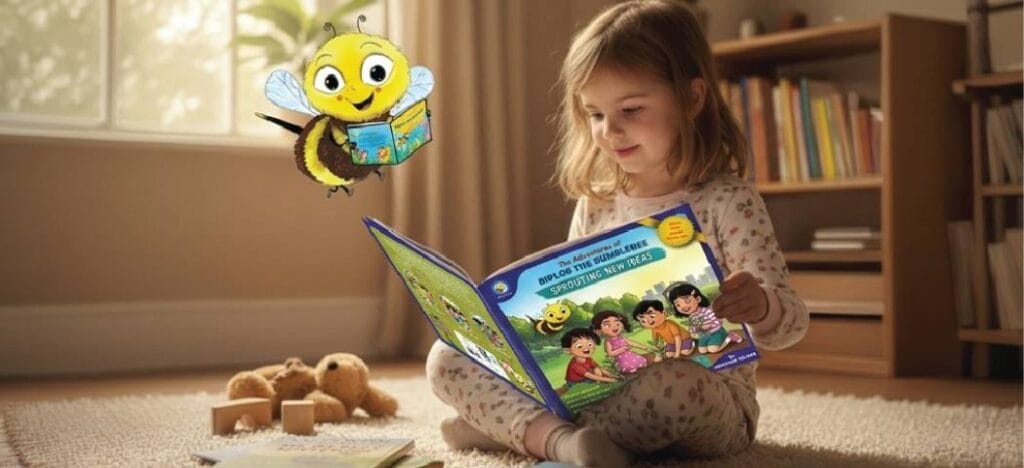
When children follow Adventures of Biplob the Bumblebee, they enter the natural world through a small but memorable character. They begin to understand that bees matter, flowers matter, kindness matters, and living beings are connected.
This is not a lecture on sustainability.
It is an invitation to care.
And that is far more powerful.
Adventures of Biplob the Bumblebee
Show children how small actions add up
Inculcating a love for nature is the first step.
Equally crucial is showing children how they can make a difference.
There are easy-to-implement changes we can make in our lifestyle. Each may seem small, but the cumulative impact can be staggering. Imagine a billion-plus Indians practising these changes in their lives.
That is not a small change.
That is a movement.
For children, this understanding often deepens when the idea is reinforced through play. A board game like Net Zero can help them understand that every sustainability initiative has consequences. Save energy here, reduce waste there, manage resources better, make one choice over another — the child begins to see that sustainability is not one grand heroic act.
It is a series of choices.
Sustainability tweak 1: switch off what you are not using
This is the simplest one.
Shut all appliances like lights, fans, air-conditioners and chargers when leaving a room.
That is it.
No ceremony required.
For children, this is one of the easiest sustainability habits to practise because it is visible and immediate. A child can see whether the light is on. She can see whether the fan is running. She can be given the responsibility to check the room before leaving.
You can even turn it into a small family role.
“Energy monitor” sounds far more exciting than “person who nags everyone about switches.”
Though, let’s be honest, both may happen.
A game like Net Zero can make this idea more meaningful because it helps children understand that energy use is not invisible. Every choice adds up.
Sustainability tweak 2: save water without making a speech
Keep the faucet shut while brushing and showering. Open it only when you actually need to gargle, clean or wash.
This sounds obvious.
It is also ignored in millions of homes every day.
Children understand water better when they use it consciously. Ask them to fill a glass and brush using only that much water. Show them how much water flows from a tap in one minute. Let them water a plant and watch how little is actually needed.
Do not make it frightening.
Make it observable.
Sustainability becomes meaningful when children can see waste happening.
A story, puzzle or activity around nature can also lead naturally to questions about water. Plants need water. Bees need flowers. Animals need clean habitats. Ecosystems depend on balance.
This is where the idea begins to settle.
Adventures of Biplob the Bumblebee
Story-Based Jigsaw Puzzles
Sustainability tweak 3: reuse before buying new
Reuse what you can and recycle what you cannot.
For instance, for school projects, use old newspapers instead of buying new paper. Old curtains can become washcloths. Cardboard boxes can become forts, models, sorting trays or craft material. Empty jars can become storage. Used paper can become rough-work sheets.
Children love reuse once they see it as creativity rather than compromise.
This is also where hands-on learning becomes useful.
A STEM.org certified DIY kit can help children understand how materials, design and problem-solving work together. It encourages them to build, test, assemble and think. Once a child begins to build with her hands, the idea of reuse becomes far more natural.
She begins to ask:
Can this be used again?
Can this be made into something else?
Do we need to buy new?
Can we repair it?
That is sustainability thinking in action.
Sustainability tweak 4: segregate waste properly
If something needs to be disposed of, do so in the appropriate manner recommended.
Segregate dry and wet waste. Keep recyclables separate. Teach children what goes where. Let them help with simple sorting under supervision.
This is not glamorous work.
But it is important.
Children often enjoy sorting when it is made practical. Paper here. Plastic there. Food waste here. Reusable items elsewhere. Once they understand the categories, they begin to notice how much waste a household produces.
That awareness matters.
A sustainability board game like Net Zero can also help children understand waste not as “garbage” but as a resource problem. What we use, how we use it, and what we throw away are all connected.
Sustainability tweak 5: don’t waste
Don’t waste.
This doesn’t mean we need to scrounge. All it means is that we use only as much as we need, without wasting resources.
Food. Water. Electricity. Paper. Plastic. Clothes. Toys. Stationery. Time outdoors.
Children understand fairness. They understand when something is being used well and when something is being wasted. What they need is a clear connection.
If food is wasted, someone grew it, transported it, cooked it and served it for nothing. If electricity is wasted, energy was generated for nothing. If paper is wasted, trees and water were used for nothing.
This is not meant to guilt-trip children.
It is meant to help them see the full story behind everyday things.
A game like Net Zero can make these trade-offs visible. A child sees that choices have consequences, and that sustainability is often about balance.
Help children understand ecosystems, not just habits
Switching off lights and saving water are important.
But children should also understand that nature works as a system.
A forest is not just trees.
A pond is not just water.
A bee is not just an insect.
A tiger is not just a beautiful animal.
A fallen leaf is not just litter.
Everything has a role.
This is where Xpedition can be especially useful. A game that helps children understand how ecosystems function can make sustainability far more meaningful. Children begin to see relationships between animals, plants, habitats, resources and human choices.
Once they understand that ecosystems are connected, environmental responsibility stops feeling like a list of rules.
It begins to feel like common sense.
Use games to make consequences visible
One of the hardest things about sustainability is that consequences are often delayed.
Leave a light on today, and nothing dramatic happens. Waste water today, and the tap still works tomorrow. Throw away plastic today, and it disappears from the house.
Children need help seeing what happens after that.
Games are excellent for this.
In Net Zero, children can begin to understand the implications of different sustainability initiatives. In Xpedition, they can explore how ecosystems function and why balance matters. Through play, they see cause and effect in a way that is far more engaging than a lecture.
A choice is made.
A result follows.
A strategy changes.
A lesson lands.
That is learning.
Use puzzles and colouring books to slow the learning down
Not every sustainability conversation has to be serious.
Sometimes, a child colouring a forest scene or solving a nature-based puzzle is also learning.
A story-based jigsaw puzzle helps children see how parts make a whole. A missing piece matters. A wrong fit does not work. The final picture depends on everything being in place.
That is a rather beautiful way to think about sustainability.
A colouring book gives children time to notice details. A bee, a flower, a tree, a river, an animal, a garden. While colouring, children ask questions. Why is the bee near the flower? Why is the river blue? Why do forests have so many animals?
These questions open doors.
Story-Based Jigsaw Puzzles
Colouring Books
Make sustainability screen-free and hands-on
There is no shortage of videos explaining sustainability to children.
Some are excellent.
But children also need experiences away from screens. They need to touch, build, sort, colour, play, walk, observe, ask and do.
Screen-free sustainability learning is powerful because it makes the child an active participant.
A book invites imagination.
A board game invites decisions.
A puzzle invites patience.
A colouring book invites observation.
A DIY kit invites problem-solving.
A walk in the park invites wonder.
Together, these are far more powerful than telling a child, “Care for the planet,” and then handing over a screen.
Biplob Books
Board Games
Story-Based Jigsaw Puzzles
Colouring Books
STEM.org Certified DIY Kits
Ask better questions
Having practised this with our own children, I find that they can become bigger evangelists for the planet than we are.
The best part is that it does not always happen gradually. Sometimes it happens almost instantly.
Of course, we need to nudge them in the right direction.
Ask questions like:
“Isn’t this beauty of nature worth saving?”
“What happens if we waste this?”
“Do we really need to buy a new one?”
“Can we reuse this?”
“What happens to this after we throw it away?”
“Why do bees need flowers?”
“What happens if one part of an ecosystem disappears?”
In no time, the pupil becomes the teacher.
And then you will be the one being reminded to switch off the light.
Fair warning.
Explore sustainability through stories, games and hands-on play
Bringing sustainability home does not require dramatic lifestyle changes overnight.
Start small.
Switch off.
Save water.
Reuse.
Segregate.
Don’t waste.
Spend time in nature.
Play games that show consequences.
Read stories that build care.
Use activities that make children think with their hands.
To make these ideas easier for children to understand, start with:
- Adventures of Biplob the Bumblebee
- Net Zero board game
- Xpedition board game
- Story-based jigsaw puzzles
- Colouring books for kids
- STEM.org certified DIY kits
Each one gives children a different way to understand sustainability — through story, play, observation, choices, systems and hands-on discovery.
Explore Sustainability Learning Products
Explore Biplob Books, Board Games, Puzzles & STEM.org Certified DIY Kits
In the end
Simply put, nature-friendly parenting is one of the most joyous and fulfilling experiences.
All of us parents struggle to find things to engage with and keep our kids gainfully occupied. The good news is that nature, stories, games and hands-on play have everything needed to keep them engaged and healthy, both in mind and body.
Once we introduce children to the beauty of nature and show them how everyday choices matter, we do not have to force sustainability on them.
They begin to notice.
They begin to ask.
They begin to care.
And once that happens, sustainability stops being a subject.
It becomes a way of living.
FAQs on Bringing Sustainability Home for Kids
How can parents teach sustainability at home?
Parents can teach sustainability at home through small daily habits such as switching off unused lights, saving water, reusing materials, segregating waste, avoiding unnecessary waste, spending time in nature and using stories and games to explain why these habits matter.
What are simple sustainability habits for children?
Simple sustainability habits for children include switching off lights and fans, closing the tap while brushing, reusing paper, sorting waste, avoiding food waste, caring for plants, spending time outdoors and learning through sustainability-themed games.
How can Net Zero help children understand sustainability?
Net Zero can help children understand sustainability by showing how choices around resources, waste, energy and responsible action have consequences. It turns sustainability from an abstract idea into an engaging board game experience.
How can Xpedition help children understand ecosystems?
Xpedition can help children understand how ecosystems function by showing relationships between animals, plants, habitats, resources and balance. It helps children see nature as a connected system.
How do Biplob books support sustainability learning?
Biplob books help children connect with nature through stories. Adventures of Biplob the Bumblebee introduces ideas like bees, flowers, kindness, responsibility and care for living beings in a child-friendly way.
[Hyperlink: Adventures of Biplob the Bumblebee → Biplob book/product page]
What are good screen-free sustainability activities for kids?
Good screen-free sustainability activities include reading nature stories, playing sustainability board games, solving nature-based puzzles, colouring forests or animals, building with DIY kits, gardening, sorting waste and taking nature walks.
Board Games
Story-Based Jigsaw Puzzles
Colouring Books
STEM.org Certified DIY Kits