Sustainability for Kids: Making Big Ideas Like Global Warming Easier Through Stories and Games
There are a lot of big words floating around childhood today.
Sustainability.
Greenhouse gases.
Global warming.
Climate change.
Carbon footprint.
Pollution.
Biodiversity.
Net zero.
Adults struggle with some of these, so it is hardly fair to expect children to understand them through definitions alone.
And yet, children are growing up in a world where these ideas matter deeply. They hear about hotter summers, unusual rains, floods, droughts, plastic in oceans, disappearing forests, bees, butterflies, animals losing homes and people needing to “save the planet.”
The challenge is not whether children should learn about sustainability.
Of course they should.
The real question is: how do we make sustainability meaningful for children without frightening them, boring them or turning childhood into a lecture?
The answer, quite often, begins with something children already understand.
A story.
A game.
A character.
A puzzle.
A question.
A little moment of wonder.
Because children may not remember the textbook definition of global warming. But they will remember a bumblebee searching for flowers. They will remember a game where every choice affects the planet. They will remember a puzzle that shows nature as a connected world. They will remember colouring a character and asking, “Why do bees need flowers?”
That is where real learning begins.
Adventures of Biplob the Bumblebee
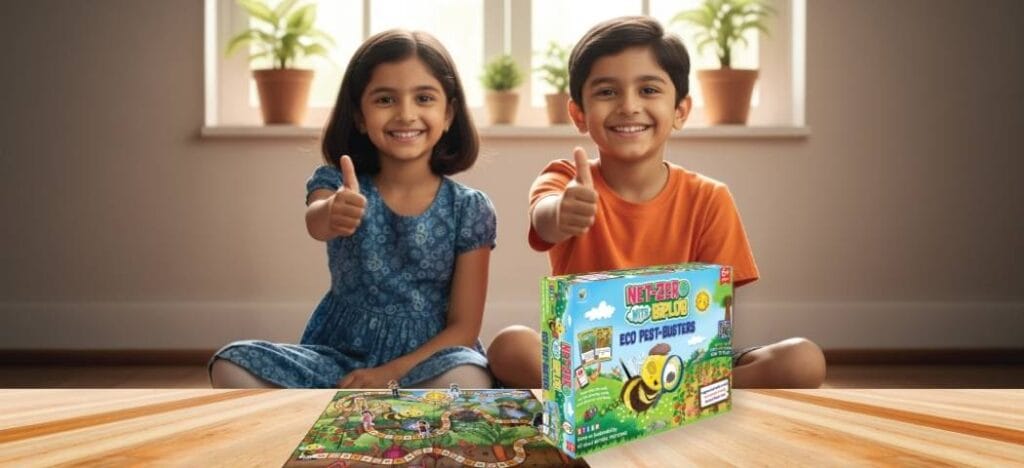
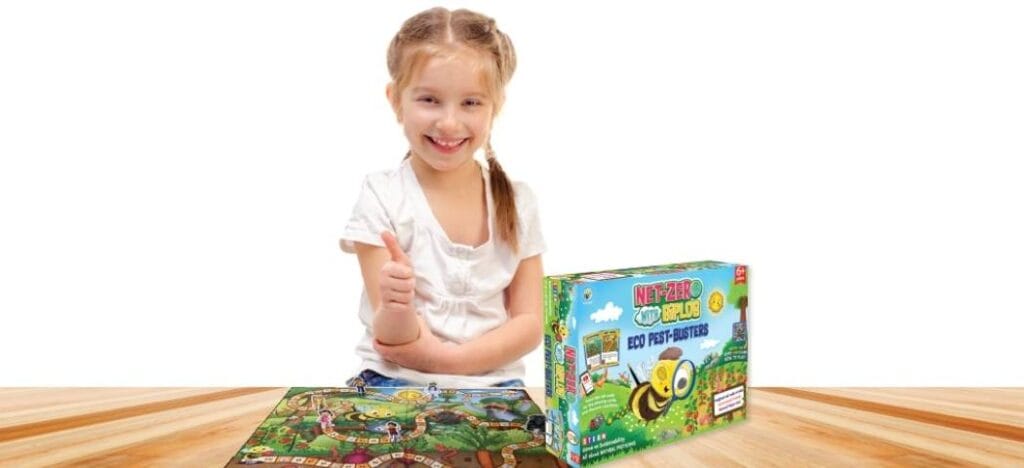
Net Zero board game
Story-based Jigsaw Puzzles
Colouring Books
Quick answer: how can children understand sustainability?
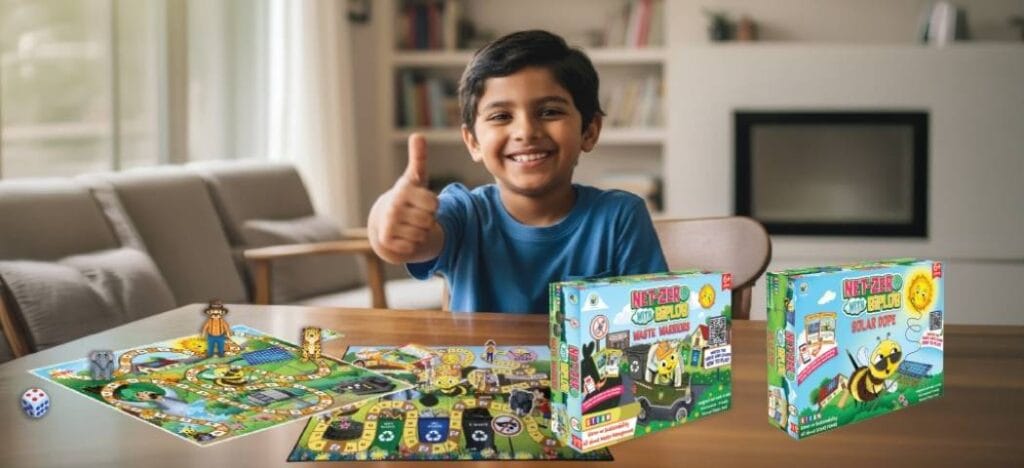
Sustainability for kids is easiest to understand when it is taught through stories, games and hands-on activities. Biplob books, the Net Zero board game, story-based jigsaw puzzles, colouring books and STEM.org certified DIY kits help children understand ideas like nature, waste, resource use, global warming and climate change through play rather than lectures.
This is not about making children memorise definitions. It is about helping them see connections.
A bee needs flowers.
Flowers need clean air, soil, water and seasons.
People need plants, food and nature.
If the balance is disturbed, everyone is affected.
Once children understand that connection, sustainability stops sounding like a big adult word.
It begins to make sense.
Why sustainability is difficult for children to understand
Sustainability is not one idea. It is a web of ideas.
It includes nature, pollution, energy, water, waste, climate, food, forests, oceans, animals, insects, cities, transport and human choices.
Now imagine explaining all of that to a seven-year-old.
You could begin with greenhouse gases, fossil fuels, industrialisation, carbon sinks and emissions pathways.
Or you could begin with a bee.
A bee needs flowers.
Flowers need clean air, soil, water and seasons.
People need plants, food and nature.
If the balance is disturbed, everyone is affected.
Suddenly, sustainability is not an abstract word.
It is a living relationship.
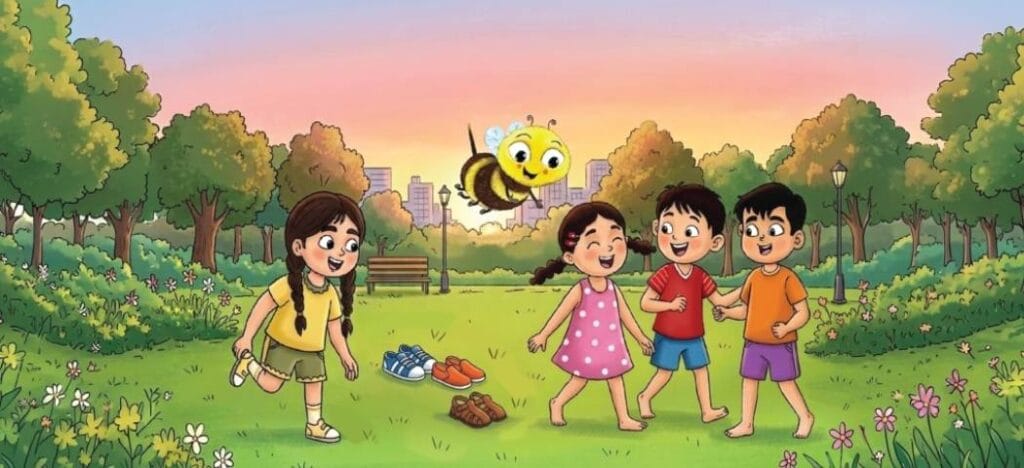
This is why nature-led stories work so well for children. In Adventures of Biplob the Bumblebee, Biplob gives children a small, familiar doorway into a much larger world. Through a bee’s journey, children begin to see that nature is not background scenery. It is alive, connected and worth caring for.
Adventures of Biplob the Bumblebee
From big climate words to child-sized understanding
Words like greenhouse gases, global warming and climate change can feel intimidating.
For children, the first step is not memorising scientific terms. The first step is understanding relationships.
When we use too much energy, burn too much fuel, waste too much, cut too many trees and produce more than we need, the Earth’s balance is disturbed. This leads to warming, changing weather patterns and stress on plants, animals and people.
That is the adult explanation.
For children, it becomes easier when the idea is made visible.
A flower patch disappears.
A bee has to search harder for nectar.
A forest becomes smaller.
A river becomes dirty.
A child makes a choice in a game.
A family decides to waste less.
A story shows that every action has a consequence.
This is not dumbing down sustainability.
It is making sustainability visible.
Adventures of Biplob the Bumblebee
Net Zero board game
How stories demystify global warming
Global warming is usually explained as the Earth getting warmer because too many greenhouse gases trap heat in the atmosphere.
That is accurate, but not always memorable for a child.
A story can make the same idea easier to grasp.
Imagine a child reading about a hot summer where flowers bloom differently, bees have to work harder, water becomes precious and animals struggle to find shade. The child begins to see that warming is not just a number on a chart. It affects living beings.
This is where stories can do what definitions cannot.
They connect the head and the heart.
Through Biplob’s adventures, children can begin to understand that nature works through balance. Bees, flowers, trees, water, soil and people are all connected. When one part is disturbed, the effects ripple outward.
That is the beginning of climate understanding.
How games make sustainability active
Stories help children care.
Games help children act.
A sustainability-themed game can show children that choices matter. Should we waste resources or conserve them? Should we think only of today or also of tomorrow? Should we act alone or work together?
This is why games are powerful learning tools.
In a game, a child does not merely hear about sustainability. The child makes choices, sees consequences, changes strategy and tries again. That is far more engaging than a lecture.
A board game built around sustainability or net-zero thinking can quietly introduce children to ideas like resource use, balance, responsibility, trade-offs and collective action.
They may not use these exact words.
But they begin to understand the logic.
Sustainability-themed game
Board Games collection
How puzzles and colouring books make abstract ideas tangible
Not every child learns by listening.
Some children learn by doing.
That is where puzzles, colouring books and hands-on activities become important.
A story-based jigsaw puzzle can help children see nature as a complete picture made of connected parts. A missing piece matters. A wrong fit does not work. The final picture comes together only when every part finds its place.
That is a beautiful metaphor for sustainability.
A colouring book allows children to slow down and engage with characters, animals, plants and scenes. While colouring a bee, a flower or a forest, a child may ask questions.
Why do bees need flowers?
Why should we not cut trees?
Why does clean water matter?
Why do animals need safe homes?
These small questions are the beginning of environmental awareness.
Story-based Jigsaw Puzzles
Colouring Books
How DIY kits support sustainability thinking
Children understand best when they can touch, build and test ideas.
That is why hands-on learning matters.
A STEM.org certified DIY kit can help children explore science, design, problem-solving and cause-and-effect thinking. When a child builds something, experiments with materials, follows steps or solves a challenge, sustainability becomes less abstract.
They begin to understand that the world is made of systems.
Things connect.
Choices matter.
Design matters.
Resources matter.
Waste matters.
This is the foundation of sustainability thinking.
A child who builds, tests, adjusts and tries again is learning far more than how to complete an activity. The child is learning how actions lead to outcomes. That is a useful idea in science, and an even more useful idea in sustainability.
Why screen-free sustainability learning matters
There is no shortage of videos explaining climate change to children.
Some are excellent.
But children also need learning experiences away from screens. They need to read, build, colour, solve, discuss, imagine and play.
Screen-free sustainability learning gives children time to engage more deeply. A story invites conversation. A puzzle invites patience. A board game invites decision-making. A colouring book invites observation. A DIY kit invites experimentation.
Together, these experiences make sustainability something children can touch and participate in.
Not just watch.
Biplob Books collection
Board Games collection
STEM.org Certified DIY Kits collection
Sustainability should not scare children
Climate change can be a frightening subject.
Handled badly, it can make children feel helpless. Handled well, it can make them feel curious, responsible and hopeful.
That distinction matters.
Children do not need to be scared into caring for the planet. They need to notice it, love it and feel that their actions matter.
A child may begin by loving a character. Then a bee. Then a flower. Then a tree. Then a garden. Then the larger world.
That is how care grows.
Not through fear.
Through connection.
Sustainability concepts children can discover through books and games
Story-led books, games and activities can gently introduce children to important sustainability concepts, including:
Nature and biodiversity
Bees and pollination
Clean air and water
Waste and reuse
Resource conservation
Climate balance
Global warming
Greenhouse gases
Food chains and ecosystems
Cause and effect
Responsible choices
Community action
Screen-free learning
STEM thinking
The aim is not to turn children into climate scientists overnight.
The aim is to help them become curious, caring and aware.
Once that happens, deeper learning follows naturally.
How parents can start sustainability conversations
Parents do not need to sit children down for a formal lesson on global warming.
In fact, please don’t.
Start with the story, game or activity in front of you.
While reading a Biplob story, ask:
“Why do you think bees are important?”
“What would happen if there were no flowers?”
“How can we help nature around us?”
While playing a sustainability-themed board game, ask:
“What happens when we use too many resources?”
“Which choice helped the planet?”
“Can we do something like this at home?”
While solving a puzzle, ask:
“What do you see in this picture?”
“How are the animals, plants and people connected?”
While colouring, ask:
“What colours would make this garden healthy?”
“What does a happy forest need?”
These are simple questions.
But they invite children to think.
Where global warming fits into a child’s world
Global warming is not an isolated topic.
It is connected to how we use energy, how much we consume, how we travel, how we produce, how we waste and how we care for nature.
The science is straightforward: industrial production, transport and consumption release greenhouse gases. These gases trap heat. The Earth warms. Climate patterns change. Seasons shift. Floods, droughts, heatwaves and ecological disruptions become more frequent.
But for children, the important point is simpler:
When humans disturb nature’s balance, the effects are felt everywhere.
A bee needs flowers.
Flowers need seasons.
Seasons need climate balance.
People need nature.
Nature needs care.
That is how a large idea like global warming becomes understandable.
A gentler way to raise eco-conscious children
Raising eco-conscious children does not require dramatic speeches about the end of the world.
It begins in smaller ways.
Reading a story about nature.
Playing a game where choices matter.
Solving a puzzle that shows the natural world.
Colouring a forest, bee or flower.
Building something with care.
Asking why water should not be wasted.
Wondering where birds go when trees disappear.
These are small moments, but they matter.
Children who learn sustainability through stories and play are not merely memorising facts. They are developing a way of seeing the world.
And once a child begins to see the world as connected, sustainability stops being a chapter.
It becomes common sense.
Explore sustainability through stories and play
Looking for ways to help children understand sustainability, global warming and climate change without turning it into a lecture?
Start with stories, games and hands-on play:
Adventures of Biplob the Bumblebee
Net Zero board game
Story-based jigsaw puzzles
Colouring books for kids
STEM.org certified DIY kits
Each one gives children a different way to imagine, observe, ask, solve and care — one story at a time.
Explore Sustainability Learning Products
FAQs on Sustainability, Global Warming and Learning Through Stories
How can children understand sustainability?
Children understand sustainability best through stories, games and hands-on activities. Books, board games, puzzles, colouring books and DIY kits help them see how nature, people, resources and choices are connected.
How do Biplob books teach sustainability?
Biplob books introduce children to nature, bees, pollination, empathy and care for living beings through story-based learning. This makes sustainability easier to understand and remember.
How can games teach global warming and climate change?
Games help children make choices, see consequences and understand responsibility. A board game like Net Zero can introduce ideas like resource use, balance, waste reduction and climate action.
Why are stories better than lectures for teaching climate concepts?
Stories make complex ideas emotional, relatable and memorable. Children may forget definitions, but they remember characters, problems, adventures and solutions.
How can parents explain global warming using Biplob?
Parents can use Biplob stories to show how nature is connected. Bees need flowers, flowers need seasons, and seasons depend on climate balance. This helps children understand global warming through familiar examples.
What products are useful for sustainability learning?
Useful products include Adventures of Biplob the Bumblebee, Net Zero board game, story-based jigsaw puzzles, colouring books and STEM.org certified DIY kits.
Adventures of Biplob the Bumblebee
Net Zero board game
Story-based jigsaw puzzles
Colouring books
STEM.org certified DIY kits