
Who Really Ruled Travancore? The Fascinating Mystery of Padmanabhaswamy Temple
Every now and then, history presents us with a story so unusual that it sounds almost fictional.
A powerful king builds a successful kingdom.
He wins battles.
Expands his territory.
Strengthens his administration.
And then, at the height of his power, he does something entirely unexpected.
He gives the kingdom away.
Not to another ruler.
Not to a conquering army.
Not to a family member.
He gives it to a deity.
At first glance, it sounds impossible.
Yet that is exactly what happened in eighteenth-century Travancore.
The king was Marthanda Varma.
The deity was Lord Padmanabha.
And the place at the heart of this remarkable story was the Padmanabhaswamy Temple in present-day Thiruvananthapuram.
Most people encounter the temple through stories about its enormous treasure vaults. Those stories are certainly fascinating, and we will come to them shortly.
But if you ask me, the treasure is not the most interesting mystery here.
The real mystery is this:
How did a deity become the ruler of an entire kingdom?
And why did generations of kings willingly serve as the deity’s representatives rather than claim the throne for themselves?
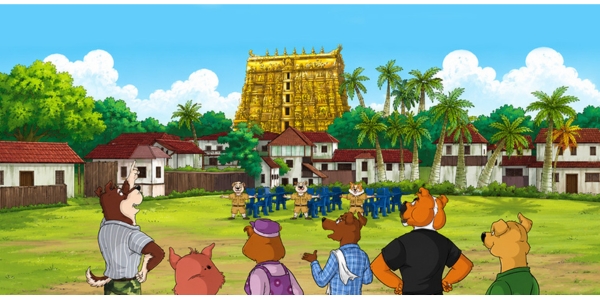
That is the sort of question Detective Col. Zoro would find impossible to ignore.
Detective Col. Zoro Book 5 – Padmanabhaswamy Temple
Quick Answer: Why Is Padmanabhaswamy Temple Famous?
Padmanabhaswamy Temple in Thiruvananthapuram is famous for three reasons.
First, it is one of the most important Vishnu temples in India.
Second, it is associated with the Travancore royal family and King Marthanda Varma’s decision to dedicate his kingdom to Lord Padmanabha.
Third, it became internationally famous after vast treasures were discovered in several temple vaults during modern investigations.
Together, these elements make it one of India’s most fascinating historical and cultural landmarks.
The Temple Before the Kingdom
One of the easiest mistakes to make when learning about Padmanabhaswamy Temple is to assume that the temple became important because of Travancore.
The reality is almost the opposite.
The temple was already ancient long before Travancore emerged as a major kingdom.
References to the site appear in historical records, traditions and literary works dating back many centuries. The deity worshipped here, Lord Vishnu reclining on the serpent Anantha, gave the city its very name.
Thiruvananthapuram literally means:
“The City of Lord Anantha.”
Which means the temple was not simply located within the kingdom.
In many ways, the kingdom grew around the temple.
And that distinction becomes important later.
Because when Marthanda Varma made one of the most extraordinary decisions in Indian history, he was building upon traditions that already ran deep.
The King Who Changed Everything
By the early eighteenth century, Marthanda Varma had transformed Travancore into one of the strongest kingdoms in southern India.
He defeated rivals.
Expanded the state’s territory.
Strengthened administration.
Modernised the military.
By almost any measure, he was a successful ruler.
Which makes what happened next all the more remarkable.
In 1750, Marthanda Varma performed what became known as the Thrippadidanam.
In a symbolic act of dedication, he offered his kingdom to Lord Padmanabha.
From that point onward, the deity was regarded as the true ruler of Travancore.
The kings who followed did not describe themselves as sovereign monarchs.
Instead, they adopted the title:
Padmanabha Dasa
Servant of Lord Padmanabha.
Think about that for a moment.
Most rulers throughout history sought to increase their personal authority.
Marthanda Varma voluntarily placed himself beneath the deity he worshipped.
That alone makes this one of the most unusual political stories in Indian history.
The Kingdom with a Divine Ruler
This is where children usually start asking questions.
If Lord Padmanabha was the ruler, who actually governed the kingdom?
The answer is both simple and fascinating.
The royal family continued administering Travancore.
Laws were made.
Armies were maintained.
Taxes were collected.
The machinery of government continued functioning.
But symbolically, everything was done in the name of Lord Padmanabha.
The kings ruled as custodians rather than owners.
The distinction may seem subtle.
Yet it shaped Travancore’s identity for generations.
And it remains one of the most distinctive features of the kingdom’s history.
The Mystery Beneath the Temple
Of course, no discussion of Padmanabhaswamy Temple is complete without mentioning the treasure.
This is the part of the story that captures headlines.
For decades, stories circulated about sealed vaults hidden beneath the temple.
Many people assumed the stories were exaggerated.
Then investigations revealed that they were not.
Inside several vaults were astonishing quantities of gold, jewels, coins, ornaments and ceremonial objects accumulated over centuries.
The discoveries attracted international attention.
Suddenly, one of India’s most important temples became one of the most talked-about historical sites in the world.
Yet even here, the treasure is only part of the story.
Because every treasure raises questions.
Who donated these objects?
Over what period?
How were they preserved?
What do they tell us about trade, wealth and devotion in earlier centuries?
The gold may attract attention.
The questions are what make history interesting.
The Case of the Locked Vault
No article about Padmanabhaswamy Temple would be complete without mentioning Vault B.
Unlike several other vaults that were examined, this particular chamber remains unopened.
Naturally, this has inspired endless speculation.
Legends.
Rumours.
Conspiracy theories.
Wild guesses.
In other words, exactly the sort of thing that would attract Detective Col. Zoro.
The reality is that much about the vault remains uncertain.
And uncertainty has a way of encouraging the imagination.
Sometimes the mysteries we cannot solve become the ones we remember most.
The Clues in the Case

THE PADMANABHASWAMY MYSTERY
Inside are several clues.
- An ancient temple dedicated to Lord Vishnu.
- A city named after the deity.
- A powerful king.
- A kingdom offered to a god.
- Generations of rulers calling themselves servants.
- Hidden vaults.
- Extraordinary treasure.
- An unopened chamber.
Now comes the detective’s question.
Which clue do you think is the most surprising?
For me, it is still the king giving away his kingdom.
Not because it created a mystery.
Because it created a story unlike almost any other in history.
Visit the Temple and Let the Questions Begin
Some historical sites impress visitors with their size.
Others with their age.
Padmanabhaswamy Temple does something slightly different.
It impresses visitors with the stories it contains.
A king who surrendered a throne.
A deity who became a ruler.
Treasures hidden for centuries.
Questions that remain unanswered.
The moment children hear those stories, they start asking questions.
And that is exactly where learning begins.
Continue the Adventure
Detective Col. Zoro Book 5: Padmanabhaswamy Temple
A mystery adventure that introduces children to one of India’s most remarkable stories of kings, temples, treasure and history.
Detective Col. Zoro Book 5 – Padmanabhaswamy Temple
Detective Col. Zoro Collection
Explore more mysteries set against India’s forts, monuments, temples and historical landmarks.
Detective Col. Zoro Collection
FAQ
Why is Padmanabhaswamy Temple famous?
The temple is famous for its religious significance, its connection to the Travancore royal family and the enormous treasures discovered in its vaults.
Who was Marthanda Varma?
Marthanda Varma was the ruler of Travancore who dedicated his kingdom to Lord Padmanabha in 1750.
Why did the kings of Travancore call themselves Padmanabha Dasa?
After the kingdom was dedicated to Lord Padmanabha, the rulers considered themselves servants of the deity rather than sovereign monarchs.
What is the treasure of Padmanabhaswamy Temple?
The treasure consists of gold, jewels, coins and ceremonial objects accumulated over centuries through donations and royal patronage.
What is Vault B?
Vault B is one of the temple’s sealed chambers and remains unopened, contributing to the mystery surrounding the temple.