
Martand Sun Temple: The Magnificent Wonder That Refused to Be Forgotten
There are some historical sites that impress you because they are complete.
The Taj Mahal is one.
The Brihadeeswara Temple is another.
You stand before them and admire what survives.
Martand Sun Temple creates a very different feeling.
The first thing that strikes most visitors is not what is there.
It is what is missing.
Broken columns rise from the ground. Fragments of walls stand against the backdrop of the Kashmir Valley. Empty spaces hint at halls, carvings and structures that no longer exist. Even someone with no knowledge of history can tell immediately that this place was once extraordinary.
And that is where the questions begin.
Who built it?
Why was it built here?
How magnificent was it in its prime?
And perhaps most intriguingly of all, what happened to it?
Because Martand is not simply a story about a temple.
It is a story about ambition, beauty, loss and memory.
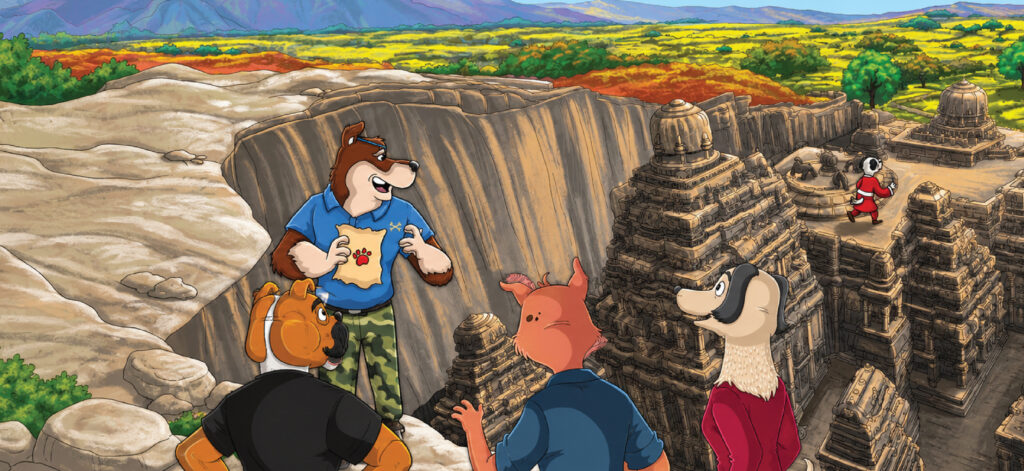
In many ways, it feels exactly like a Detective Col. Zoro mystery.
Not because nobody knows anything about it.
But because the ruins constantly remind us that there is still so much left to understand.
If your child enjoys mysteries set against India’s monuments and historical sites, Martand is one of those places that sparks curiosity almost immediately.
Detective Col. Zoro Book 4 – Martand Sun Temple
Quick Answer: Why Is Martand Sun Temple Famous?
Martand Sun Temple is an ancient Hindu temple dedicated to Surya, the Sun God, located in Kashmir.
Built during the 8th century CE by King Lalitaditya Muktapida of the Karkota dynasty, it is widely regarded as one of the finest examples of ancient Indian temple architecture.
Today, it is famous not only for its beauty and historical importance but also because much of the temple survives only as ruins, making it one of India’s most evocative and intriguing historical sites.
A Temple Built to Match the Landscape
One of the things photographs struggle to capture about Martand is its setting.
The temple sits on a plateau overlooking the Kashmir Valley, and there is a moment when most visitors realise that the builders knew exactly what they were doing. This was not simply a convenient piece of land on which to construct a temple. The location feels chosen.
The valley stretches out below. Mountains frame the horizon. The sky seems unusually vast.
Even today, standing among the ruins, it is difficult not to pause for a moment and simply look.
King Lalitaditya Muktapida, who commissioned the temple in the eighth century, was responsible for creating one of the most remarkable monuments in ancient India. Scholars often point out the blend of architectural influences visible in the structure, but what strikes many visitors first is something simpler.
Scale.
Even in ruins, Martand feels grand.
You find yourself imagining what the complex must have looked like when its courtyards were intact, its carvings complete and its walls standing at their full height.
The imagination does a great deal of work at Martand.
Perhaps that is one reason the site remains so memorable.
The King Behind the Temple
Every great monument begins with an idea.
In this case, the idea belonged to Lalitaditya Muktapida, one of the most powerful rulers of the Karkota dynasty.
Historical accounts describe him as an ambitious king whose influence extended far beyond Kashmir. During his reign, the kingdom flourished, and Martand became one of its most impressive achievements.
The temple was dedicated to Surya, the Sun God, but it was also something more.
It was a statement.
A declaration of confidence, prosperity and artistic ambition.
Even today, more than a thousand years later, the surviving ruins continue to communicate that sense of grandeur.
The builders may be long gone, but their confidence still lingers in stone.
The Architecture That Still Amazes Historians
One of the reasons Martand occupies such an important place in Indian architectural history is that it does not fit neatly into a single category.
The temple reflects influences from Gandharan, Gupta and Kashmiri traditions, creating a style that feels distinctively its own.
At its centre stood the main shrine. Around it stretched a large courtyard surrounded by smaller cells and impressive colonnades.
Visitors today often find themselves trying to reconstruct the monument in their minds.
What did the carvings look like?
How did sunlight move through the complex during the day?
What ceremonies took place here?
How many people worked on its construction?
The ruins do not answer these questions directly.
Instead, they invite us to keep asking them.
When History Takes a Difficult Turn
Every historical site has moments of triumph.
Some also have moments of tragedy.
Martand’s story includes both.
At some point after centuries of standing proudly over the Kashmir Valley, the temple suffered extensive destruction. Historical accounts often connect this to the reign of Sultan Sikandar in the late fourteenth and early fifteenth centuries, although historians continue discussing the details and sources surrounding the event.
What is not disputed is the outcome.
The magnificent temple was reduced to ruins.
Whenever I visit historical sites like Martand, I find myself wondering about the people who witnessed these changes.
Did they imagine that future generations would still be talking about the monument centuries later?
Could they have imagined that visitors from across India would continue coming here simply to stand among the remains and reflect on what once existed?
History rarely provides answers to such questions.
But it certainly encourages us to ask them.
The Case of the Missing Temple
One of the reasons Martand feels so perfectly suited to Detective Col. Zoro is that the mystery is hiding in plain sight.
Unlike Dwarka, we are not searching for a city beneath the sea.
Unlike Ajanta, we are not rediscovering caves hidden by forests.
The evidence is right in front of us.
The question is how to interpret it.
Imagine arriving at Martand with no prior knowledge of the site.
What would the ruins tell you?
Would you recognise that this was once a place of immense importance?
Would you be able to estimate its size?
Would you wonder why it was damaged?
Would you ask who built it?
Children are often surprisingly good at this exercise.
They notice details adults overlook.
And before long, they find themselves doing exactly what historians do.
They start asking questions.
That spirit of investigation sits at the heart of the Detective Col. Zoro series.
Detective Col. Zoro Book 4 – Martand Sun Temple
The Clues in the Case
Imagine Col. Zoro handing you a file marked:
THE MARTAND MYSTERY
Inside are a handful of clues.
A powerful king commissions an extraordinary temple.
The monument becomes one of Kashmir’s architectural masterpieces.
Centuries pass.
Political and cultural changes reshape the region.
The temple suffers extensive damage.
The ruins survive.
Future generations continue asking questions.
Now comes the detective’s challenge.
Which part of the story do you think matters most?
The construction?
The destruction?
Or the fact that the monument was remembered at all?
History often focuses on what was lost.
Martand also reminds us to think about what survived.
Visit Martand and Let History Do the Talking
Some monuments require long explanations.
Martand is not one of them.
The site has a way of speaking for itself.
Children do not need to know every historical detail before arriving.
The ruins take care of that.
They notice the surviving columns.
They look across the valley.
They realise the scale of the structure.
And almost inevitably, they start asking questions.
What happened here?
Who built this?
Why is it broken?
Could it ever be rebuilt?
That curiosity is worth far more than memorising dates.
Because curiosity transforms history from information into discovery.
And discovery is what children remember.
Continue the Adventure
Detective Col. Zoro Book 4: Martand Sun Temple
A historical mystery that introduces children to one of India’s most fascinating monuments while encouraging curiosity, investigation and a love for heritage.
Detective Col. Zoro Book 4 – Martand Sun Temple
Detective Col. Zoro Collection
Explore more mysteries set against India’s forts, temples, monuments and historical landmarks.
Detective Col. Zoro Collection
FAQ
Why is Martand Sun Temple famous?
Martand Sun Temple is famous for its remarkable architecture, historical significance and dramatic ruins overlooking the Kashmir Valley.
Who built Martand Sun Temple?
The temple was built in the 8th century CE by King Lalitaditya Muktapida of the Karkota dynasty.
Why is Martand Sun Temple in ruins?
Historical accounts attribute its destruction to later political and religious conflicts, although historians continue discussing specific details and sources.
What deity was worshipped at Martand Sun Temple?
The temple was dedicated to Surya, the Sun God.
Can families visit Martand Sun Temple today?
Yes. The ruins remain one of Kashmir’s most important historical and architectural sites.