
Ram Setu: Myth, Memory or Historical Reality?
Some stories disappear with time.
Others survive for centuries.
And a very small number survive for millennia.
The story of Ram Setu belongs firmly in that last category.
For thousands of years, generations of Indians have heard the story of a bridge built across the sea by Lord Rama’s army on its journey to Lanka. The story appears in the Ramayana, one of India’s most enduring epics, and has been passed from one generation to the next through literature, performance, tradition and oral storytelling.
Ordinarily, that might be where the discussion ends.
A story remains a story.
A legend remains a legend.
Except there is a complication.
Between India and Sri Lanka lies a chain of limestone shoals and sandbanks visible even from space.
And that is where the mystery begins.
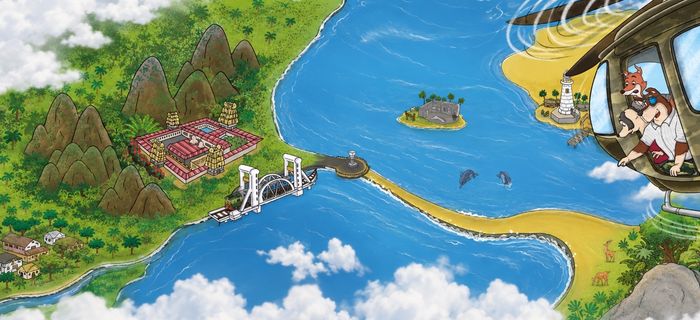
It is precisely this question that lies at the heart of Mystery of the Mythical Bridge, one of the most intriguing adventures in the Detective Col. Zoro series. Rather than asking children to choose between myth and history, the story invites them to investigate a more fascinating possibility.
What if some myths are actually memories?
What Is Ram Setu?
Ram Setu, often referred to internationally as Adam’s Bridge, is a chain of natural formations stretching between Dhanushkodi in India and Mannar Island in Sri Lanka.
Viewed from above, the formation appears remarkably bridge-like.
It extends across the shallow waters separating the two countries and has been known to travellers, geographers and local communities for centuries.
References to the structure appear in historical records dating back hundreds of years.
Ancient maps often depict a connection between the two landmasses.
In fact, historical accounts suggest that portions of the crossing may once have been navigable on foot or through extremely shallow waters before storms and changing sea levels altered the landscape.
Whether entirely natural, partially modified or something more complex remains the subject of continuing discussion.
The Satellite Images That Captured Global Attention
Few moments have reignited interest in Ram Setu more than the publication of satellite imagery showing the formation stretching between India and Sri Lanka.
The images immediately captured public imagination.
Viewed from above, the formation appears strikingly similar to a bridge.
For many observers, the photographs seemed to confirm what Indian traditions had been saying for thousands of years.
It is important, however, to understand what satellite imagery can and cannot tell us.
The images clearly show the existence of the formation.
They do not automatically reveal how it originated.
That question requires geological, archaeological and historical investigation.
Yet the images remain significant because they demonstrate something important.
The structure described in ancient tradition corresponds to a real geographical feature that exists today.
What Does Geology Tell Us?
Geologists have studied the Ram Setu region extensively.
The area consists primarily of limestone shoals, sandbanks, coral formations and sedimentary deposits.
Different studies have reached different conclusions regarding the age and formation of these structures.
Most geologists agree that natural geological processes played a major role in creating the chain of formations visible today.
The more interesting question is whether human activity may have interacted with or modified an existing natural structure.
This possibility remains a subject of debate.
What makes Ram Setu so fascinating is that the conversation has never been limited to a simple choice between “entirely natural” and “entirely artificial.”
Reality is often more complicated than such binaries.
History frequently builds upon geography.
Human beings often modify natural landscapes rather than create them from scratch.
The Historical References
One of the strongest reasons Ram Setu continues to attract attention is that references to a crossing between India and Sri Lanka appear across multiple traditions.
The Ramayana is the most famous source.
Yet references to the structure are not confined to a single text.
Travellers, regional traditions and historical records have all acknowledged the existence of a connection between the two landmasses.
The names may vary.
The interpretations may differ.
The physical feature itself remains remarkably consistent.
This is where the story becomes particularly intriguing.
The persistence of a memory across centuries does not automatically prove every detail of the original account.
Yet neither should such continuity be dismissed lightly.
Especially in a civilisation with India’s extraordinary tradition of oral transmission.
When Myths Preserve History
Modern audiences sometimes assume that myths and history belong in separate categories.
Ancient cultures rarely viewed them that way.
Stories often served as vehicles for preserving memory.
Important events were remembered through narrative.
Geography was encoded through legend.
Historical experiences survived through storytelling.
India, perhaps more than most civilisations, excelled at this.
Long before printing presses, communities transmitted knowledge through oral traditions of astonishing sophistication.
Genealogies survived.
Poetry survived.
Philosophy survived.
Entire epics survived.
If such traditions could preserve vast bodies of knowledge, is it really impossible that they might also preserve memories of real places?
This is not proof.
But it is a question worth asking.
Why India’s Myths Deserve Serious Attention
One of the mistakes we sometimes make is assuming that ancient stories must be either completely true or completely fictional.
Reality rarely works that way.
Many historical discoveries have emerged from stories once dismissed as legend.
Ancient Troy was once considered mythical.
Several locations mentioned in old texts were once thought imaginary.
Archaeology has repeatedly demonstrated that stories can preserve fragments of genuine historical memory.
The challenge is determining which fragments.
Ram Setu occupies precisely this fascinating territory.
It sits at the intersection of mythology, geology, history and geography.
That is what makes it such a compelling mystery.
Exploring Ram Setu Through Detective Col. Zoro
This is exactly why Ram Setu provides such a fascinating backdrop for Mystery of the Mythical Bridge.
Rather than presenting the bridge as a settled question, the story encourages children to think like investigators.
What evidence exists?
What does geology reveal?
What do historical texts say?
How reliable are oral traditions?
Can myths contain historical truth?
As Detective Col. Zoro follows clues across one of India’s most famous historical mysteries, young readers learn an important lesson.
Good investigators do not begin with conclusions.
They begin with questions.
Why The Mystery Matters More Than The Answer
Perhaps the most interesting thing about Ram Setu is not whether every debate surrounding it is eventually resolved.
The more interesting question is why the story continues to endure.
Thousands of years after the Ramayana was first composed, people still discuss the bridge.
Scientists study it.
Historians debate it.
Pilgrims visit it.
Children remain fascinated by it.
Very few stories achieve that level of longevity.
That alone suggests there is something extraordinary here.
Final Thoughts
Whenever I think about Ram Setu, I find myself returning to a simple possibility.
Perhaps myths are not the opposite of history.
Perhaps some myths are history remembered differently.
Retold.
Simplified.
Expanded.
Preserved.
Passed from one generation to the next until the original event becomes difficult to separate from the story surrounding it.
Whether Ram Setu ultimately proves to be entirely natural, partially modified or something else altogether, the mystery itself remains valuable.
Because it reminds us that ancient traditions deserve investigation rather than dismissal.
And because sometimes the most fascinating discoveries occur when stories and evidence unexpectedly meet.
For parents looking to introduce children to this spirit of inquiry, Mystery of the Mythical Bridge offers an engaging gateway into one of India’s most enduring historical mysteries.
Because history becomes far more interesting when we stop arguing about stories and start investigating them.
Frequently Asked Questions
What is Ram Setu?
Ram Setu is a chain of limestone shoals and sandbanks connecting India and Sri Lanka, traditionally associated with the bridge described in the Ramayana.
Is Ram Setu visible from space?
Yes. Satellite imagery clearly shows the chain of formations stretching between India and Sri Lanka.
Did NASA prove Ram Setu was man-made?
No. NASA imagery confirms the existence of the formation but does not determine whether it is natural, artificial or modified by human activity.
Why is Ram Setu important?
Ram Setu is significant because it sits at the intersection of mythology, geography, geology and Indian cultural history.
How can children learn about Ram Setu?
Books such as Mystery of the Mythical Bridge introduce young readers to the history, mystery and evidence surrounding Ram Setu through engaging storytelling.